
Walk down the grass seed aisle at any garden center and you’ll find a dozen bags making a dozen different promises, and almost none of them say plainly which one actually belongs on a Cecil County lawn. Picking the best grass seed for Maryland conditions isn’t about finding a magic variety — it’s about matching seed to a specific, fairly demanding climate, and most of the disappointing lawns in this region trace back to seed that was never suited to the job in the first place.
This guide breaks down exactly which grass types work here, why, and how to read a seed label well enough to know what you’re actually buying.
Quick Recommendation for Most Cecil County Lawns
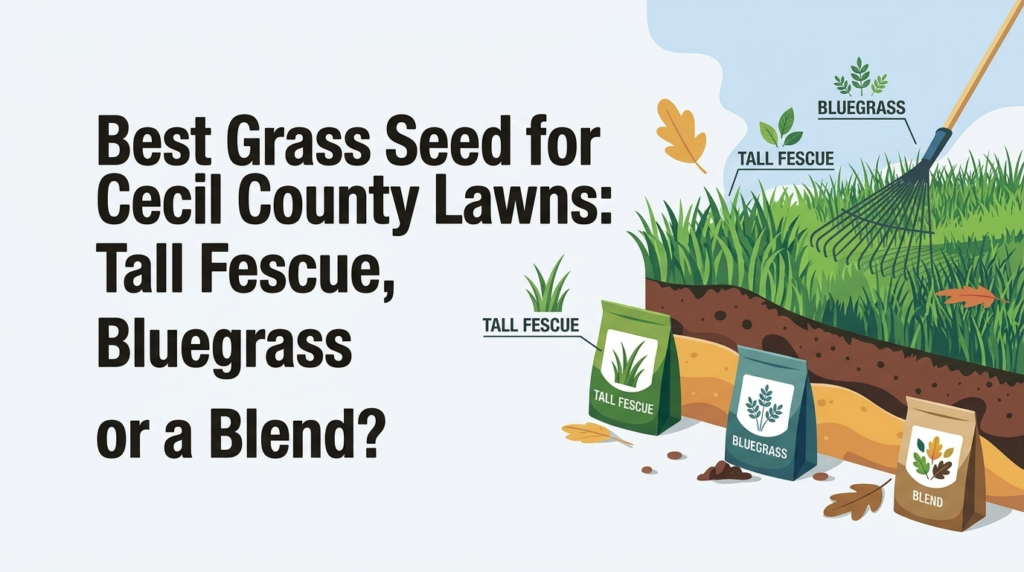
For the overwhelming majority of lawns in Cecil and Harford County, a turf-type tall fescue blend — ideally 90 to 95% tall fescue with a small percentage of Kentucky bluegrass mixed in for self-repair — is the right call. It’s the most drought-tolerant, disease-resistant cool-season option available for this climate, it’s what most established lawns in the area are already growing, and it performs reliably in both full sun and the moderate shade found around most residential yards.
The exceptions are worth knowing: heavily shaded areas do better with a fine fescue blended in, and nothing in this region should be seeded with perennial ryegrass or Kentucky bluegrass as the primary, stand-alone species — both belong in supporting roles, not the leading one. The rest of this guide explains why.
Why Maryland Is a Challenging Turf Environment
Cecil and Harford County sit in what turf scientists call the transition zone — too far north and too cold in winter to reliably grow warm-season grasses like bermuda or zoysia, but hot and humid enough in summer to put real stress on the cool-season grasses that do survive winter here. That combination means local lawns are essentially fighting a two-front war every year: cold-season survival and hot-season endurance, with no grass species perfectly built for both extremes.
Add to that the clay-heavy soils common throughout the region, which compact easily, drain slowly, and heat up faster than sandy soil, plus the disease pressure that comes with Maryland’s humid summers, and it becomes clear why generic, one-size-fits-all grass seed sold nationally so often underperforms here. Seed genetics matter more in a climate like this than in a milder one.
Tall Fescue
Tall fescue is the standard recommendation for most Maryland residential lawns, and for good reason — it handles this region’s specific combination of stresses better than any other widely available cool-season grass.
Pros: Excellent drought tolerance relative to other cool-season grasses, along with better overall pest and disease resistance. It develops a deep, coarse root system that handles clay soil and dry spells better than shallower-rooted species.
Limitations: It’s vulnerable to brown patch, a fungal disease that shows up during Cecil County’s hot, humid summers, especially on lawns that are over-fertilized with nitrogen during warm weather or mowed too short.
Where it performs best: Full sun to moderate, dappled shade. It’s the most broadly adaptable option across Cecil and Harford County and the default choice unless a specific site condition — heavy shade, for instance — points elsewhere.
Kentucky Bluegrass
Kentucky bluegrass has a well-earned reputation for dense, attractive turf, but it’s a supporting player in this climate, not a lead.
Its biggest strength is self-repair: bluegrass spreads through underground rhizomes, which means it can fill in small bare patches and damaged areas on its own over time — something tall fescue, as a bunch-type grass, can’t do. That’s exactly why it’s typically blended into tall fescue seed at 5 to 10%, where it helps knit the lawn together, rather than planted alone.
On its own, bluegrass is higher-maintenance than tall fescue, with greater vulnerability to drought stress, summer patch disease, and root damage from white grubs, plus a need for more nitrogen and more frequent dethatching. It also has low shade tolerance and performs best in full sun. For most Cecil County homeowners, bluegrass belongs in the seed bag, not as the main event.
Perennial Ryegrass
Perennial ryegrass earns a place in some seed blends for one specific reason: it germinates fast, often within a week, which helps hold soil in place and reduce erosion while slower-germinating species like tall fescue are still establishing.
That’s where its usefulness ends for this region. It’s too disease-prone for Maryland’s climate — particularly susceptible to gray leaf spot, and brown patch can kill it outright — and it isn’t long-lived enough to hold up as a standalone lawn here. Used correctly, perennial ryegrass stays a minor component of a mixture, generally no more than 5 to 10%, included for its quick establishment rather than its staying power.
One label detail worth knowing: perennial ryegrass (Lolium perenne) is a different species from annual ryegrass (Lolium multiflorum), which is a cheap filler grass that dies out within a season and has no place in a quality lawn seed mix at all. The two names look similar enough on a bag to cause real confusion.
Why Quality Seed Blends Often Perform Better
A single-species lawn puts all its resilience behind one set of genetics. If that species has a weak spot — drought sensitivity, a particular disease, poor shade tolerance — the entire lawn shares that weak spot uniformly. A well-designed blend spreads that risk out instead.
The standard, well-supported approach for this region is tall fescue as the primary component (90–95% of the mix), with a small percentage of Kentucky bluegrass (5–10%) added for self-repair capability, and fine fescue worked in for any shaded portions of the yard. Each species compensates for something the others lack, and the combined genetic diversity makes the lawn as a whole more vigorous and more resistant to the specific stresses — heat, drought, disease, shade — that show up unevenly across a typical yard.
This is also different from a “blend” in the strict label sense, where the term technically means multiple cultivars of the same species combined together, while a “mixture” combines different species. In practice, most quality lawn seed products for this region are mixtures — several tall fescue cultivars as the backbone, with small amounts of other species added for specific strengths — and both approaches lean on the same underlying idea: genetic diversity outperforms a single genetic line.
Best Seed for Full Sun
For lawn areas that get six or more hours of direct sun, a tall fescue-based blend is the right choice, full stop. Tall fescue’s drought tolerance and disease resistance are most valuable exactly where sun exposure and heat are highest, and it will out-perform bluegrass or ryegrass as a primary species in nearly every full-sun scenario in this region.
Best Seed for Partial Shade
Shaded areas — under mature trees, along fence lines, on the north side of the house — need a different genetic mix. Fine fescue is the category to look for, and within that category, creeping red fescue and chewings fescue are the two most shade-tolerant options, with chewings fescue generally handling the deepest shade of the group. A quality shade seed mix will typically combine one or more fine fescue types with a smaller amount of shade-tolerant tall fescue, since full shade areas rarely support turf as densely as sunny ones regardless of seed quality.
It’s worth setting expectations here: no grass seed, however well chosen, grows thick, healthy turf in deep, all-day shade. In those spots, thinning the tree canopy or accepting a groundcover alternative is often a more realistic long-term fix than repeatedly reseeding grass that structurally can’t get enough light to thrive.
Grass Seed for Clay and Compacted Soil
Much of Cecil and Harford County sits on clay-heavy soil that compacts easily and drains slowly, and seed selection alone can’t fix a compaction problem — but it does matter. Tall fescue’s deep, extensive root system handles clay soil better than the shallower root systems of bluegrass or ryegrass, giving it a real advantage in exactly the soil conditions most common across the region.
Seed choice works best paired with addressing the compaction itself. Overseeding compacted clay soil without first relieving that compaction, whether through core aeration or another method, means new seed is still fighting the same poor seed-to-soil contact and restricted root growth that thinned the lawn out to begin with. Seed genetics and soil condition are two separate problems that need to be solved together, not one substituted for the other.
Seed Selection for Overseeding vs New Lawns
The species recommendations above apply whether you’re overseeding an existing lawn or starting one from bare soil, but the approach and the seeding rate differ meaningfully between the two.
For overseeding an established tall fescue lawn, the standard rate is about 4 pounds of seed per 1,000 square feet, and the seed should match what’s already growing — introducing a different species into an established tall fescue lawn tends to create uneven color, texture, and growth patterns rather than a uniformly improved one. Our guide to overseeding a thin lawn after summer covers that process, timing, and rate in full. (Note: confirm this is the final published URL before linking live.)
Establishing a brand-new lawn from bare soil is a different project with a heavier seeding rate — typically 6 to 8 pounds of tall fescue seed per 1,000 square feet — since there’s no existing turf to fill in around the new seedlings. New lawns are also less forgiving of timing mistakes: cool-season grass seeded from bare soil needs roughly two weeks to germinate before a hard frost can damage young seedlings, which is part of why fall lawn care timing, generally mid-August through mid-October, matters as much for new lawns as it does for overseeding existing ones. Spring seeding of a new lawn is possible but considerably more challenging than fall, since new grass has to establish before summer heat arrives rather than getting the entire winter to root first — our spring lawn recovery guide covers what to do when spring is the only realistic option.
The Seed Label: What Homeowners Should Look At
Every bag of grass seed carries a label required by law, and it tells you far more than the marketing copy on the front of the bag. A few fields are worth checking before buying:
- Purity. The percentage, by weight, of each grass type in the bag. This is where you confirm the actual species breakdown matches what you’re trying to plant — a bag advertised as a “tall fescue blend” should show tall fescue cultivars making up the large majority of that purity breakdown.
- Germination rate. The percentage of pure seed that’s viable and expected to actually grow. Look for 70% or higher; anything meaningfully lower means a large portion of what you’re paying for won’t germinate at all.
- Test date. Seed loses viability over time. Use seed within about a year of the test date, or within 18 months of the harvest date if that’s what’s listed, to get the germination rate printed on the label rather than a diminished one.
- Weed seed content. Avoid any bag listing noxious weed seed at all. Even a small percentage introduces weeds directly into the lawn you’re trying to improve.
- Other crop seed. This should be no higher than about 0.5%. Specifically check that it doesn’t include annual ryegrass, a cheap, short-lived filler species that’s a different plant from the perennial ryegrass sometimes used intentionally in quality blends.
- Inert matter. Chaff, debris, and other non-seed material. The lower this percentage, the more of what you’re buying is actually usable seed.
One additional marker worth looking for: seed labeled Maryland Certified Seed has been tested for germination and purity by the Maryland Department of Agriculture, which is a meaningful step up in reliability over an uncertified bag. Buying from a local garden center, turf supply store, or regional seed supplier — rather than a generic bag at a big national chain — also improves the odds of getting cultivars actually suited to this region rather than a national blend built for average conditions everywhere.
Grass Seed FAQs
What is the best grass seed for Cecil County, MD? A turf-type tall fescue blend — roughly 90–95% tall fescue with a small percentage of Kentucky bluegrass for self-repair — is the right choice for most Cecil County lawns. It offers the strongest combination of drought tolerance, disease resistance, and adaptability to full sun and moderate shade of any cool-season option available here.
What is the best grass for Maryland clay soil? Tall fescue. Its deep root system handles compacted, clay-heavy soil better than Kentucky bluegrass or perennial ryegrass, both of which have shallower root systems. Pairing tall fescue seed with core aeration on compacted ground gives it the best possible start.
Is tall fescue seed the right choice for Maryland lawns in general? Yes, for the large majority of lawns. It’s the most widely recommended cool-season grass for this region because it balances drought tolerance, disease resistance, and adaptability better than the alternatives. The main exception is heavily shaded areas, where a fine fescue blend performs better.
Can I mix grass seed types myself, or should I buy a pre-made blend? A quality pre-made blend from a reputable supplier is almost always the better choice. Getting the ratios right — 90–95% tall fescue with small, specific percentages of companion species — is easy to get wrong when mixing seed by hand, and a poorly balanced mix can perform worse than a single clean species.
Why does my grass seed bag matter more than the price? A cheap bag with a high percentage of annual ryegrass, low germination rate, or generic non-regional cultivars can cost more in the long run than a properly labeled, regionally suited product, since a failed or thin seeding often has to be redone. Checking the label — germination rate, purity, and species — tells you more than the price tag does.
How is grass seed selection different for shaded areas? Shaded areas need a fine fescue-heavy mix rather than a straight tall fescue blend, since fine fescues — particularly chewings and creeping red fescue — tolerate lower light levels far better than tall fescue, bluegrass, or ryegrass. Even the best shade seed mix has limits in deep, all-day shade, where thinning nearby tree canopy often matters as much as seed choice.
Grass Type Comparison for Cecil County Lawns
| Grass Type | Sun/Shade | Drought Tolerance | Best Role | Watch-Outs |
|---|---|---|---|---|
| Tall Fescue | Full sun to moderate shade | Excellent | Primary species for most lawns (90–95% of a quality blend) | Susceptible to brown patch in hot, humid summers |
| Kentucky Bluegrass | Full sun; low shade tolerance | Good, but drought-sensitive | Supporting species (5–10%) for self-repair via rhizomes | Higher maintenance; grub and summer patch risk |
| Fine Fescue | Full sun to partial/full shade | Fair to good | Shade-specific blends (creeping red, chewings, hard fescue) | Poor traffic tolerance; not for high-use areas |
| Perennial Ryegrass | Full sun | Poor | Minor component (5–10%) for fast germination/erosion control | Disease-prone; not viable as a standalone lawn here |
Not sure what’s already growing in your lawn, or whether it’s worth reseeding versus starting fresh? Request a free estimate and we’ll take a look at what will actually perform on your property.