
If you’ve fertilized, watered, and mowed on schedule and your lawn still looks thin, patchy, or tired, a compacted lawn is one of the most common — and most overlooked — reasons why. Soil compaction lawn problems don’t announce themselves the way a weed infestation or a drought does. They build up quietly underground, and by the time the symptoms show up on the surface, the soil has usually been getting denser for a season or more. This guide covers what compaction actually is, why Cecil County properties are especially prone to it, how to check for it yourself, and what does and doesn’t fix it.
What Is Lawn Compaction?
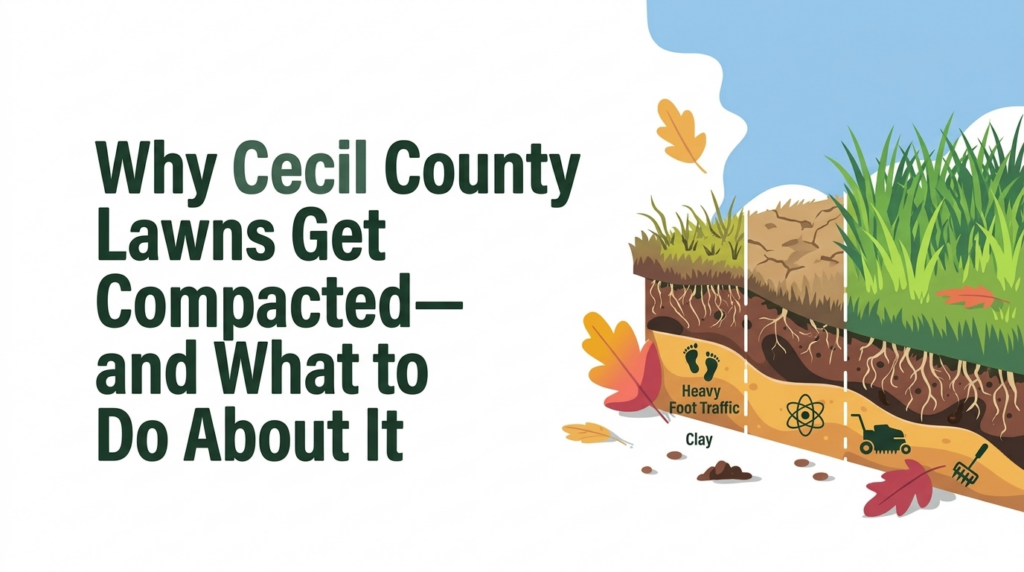
Soil is made up of solid particles with pore space between them, and that pore space is where air, water, and roots all need to move. Compaction happens when repeated pressure — foot traffic, mower wheels, parked vehicles, construction equipment, even heavy rainfall on bare soil — presses those particles closer together, squeezing out the pore space and increasing the soil’s density.
The result is a soil structure that physically resists what a healthy lawn needs to do: let water soak in instead of running off, let air reach the root zone, and let roots grow deep enough to find moisture and nutrients during dry stretches. A compacted lawn isn’t failing because of a lack of care. It’s failing because the soil underneath the grass has stopped doing its job.
Why Cecil County Properties Are Susceptible
Compaction can happen anywhere, but a few conditions specific to this region make it more common and more severe here than in areas with lighter, sandier soil.
Much of Cecil and Harford County sits on clay-heavy soil, and clay compacts far more easily than sandy or loamy soil because its particles are smaller and pack together more tightly under pressure. That same clay also drains slowly, which means it stays wet longer after rain — and wet soil compacts more easily than dry soil, since moisture lets particles slide and settle against each other rather than resisting the pressure. Winter freeze-thaw cycles and the heavy spring rains typical of this region add another layer to the problem, softening soil repeatedly through the wet season and leaving it more vulnerable to compaction from foot traffic and equipment right when lawns are trying to recover.
Add typical residential use on top of that — mowing on the same pattern every week, kids and pets running the same paths, driveways and play areas that concentrate traffic in predictable spots — and it’s easy to see why compacted lawn Maryland homeowners deal with is less an occasional problem and more a standing condition of the region’s soil and climate working against the lawn by default.
7 Signs Your Lawn Has Compacted Soil
A few consistent signals point to compacted soil rather than a watering, disease, or fertility problem:
- Water pools or runs off instead of soaking in. If rain sits on the surface or sheets toward the storm drain rather than absorbing, the soil surface has effectively sealed itself.
- Grass thins out along traffic patterns. Paths between the driveway and the door, dog runs, and mower turning points are usually the first areas to show compaction because they take the most repeated pressure.
- The soil feels hard underfoot or resists a shovel. Ground that’s genuinely difficult to dig into, even when it should be moist, is a strong physical indicator.
- Weeds that favor compacted ground start showing up. Plantain in particular — broad, ribbed leaves in a low rosette — thrives specifically in compacted soil and is one of the more reliable weed indicators of the problem.
- Moss creeps into areas that used to hold grass. Moss doesn’t need compacted soil specifically, but the combination of poor drainage and low oxygen that compaction creates is exactly the condition moss exploits.
- Grass looks stressed despite normal watering and fertilizing. Thin, pale, slow-growing turf that isn’t responding to inputs the way it should is often a soil structure problem, not a nutrition problem.
- Low spots or unevenness where water collects after rain. Compacted soil doesn’t just resist infiltration evenly — it often does so unevenly, creating soggy low points even on a lawn that looks reasonably flat.
If more than one or two of these show up in the same area, that spot is a strong candidate for aeration rather than more fertilizer or a different watering schedule.
The Screwdriver Test: A Simple Homeowner Check
The fastest way to check for compaction without any special equipment is also the most reliable for a homeowner: take a standard flathead screwdriver and press it into the soil in a few different spots around the lawn, including areas that look fine and areas you suspect are compacted.
If the screwdriver slides in two to three inches with light, steady pressure, the soil underneath is in reasonable shape. If it resists strongly, stops well short of that depth, or requires real effort or a wiggling motion to get in at all, compaction is present at that spot. Test in several locations rather than just one — compaction is rarely uniform across an entire yard, and a lawn can have healthy soil in most areas with genuinely compacted zones concentrated around high-traffic paths, play areas, or spots where equipment or vehicles have been parked.
What Compaction Does to Grass Roots
The damage compaction causes below the surface is more significant than what shows up above it. Grass roots need a minimum amount of air-filled pore space to function — research on turf and landscape soils generally puts that threshold at around 10% air-filled porosity — and compaction directly reduces that space by pressing soil particles together and eliminating the larger pores that hold air.
Roots also face a direct physical barrier in compacted soil. As soil density increases, root growth slows well before it stops completely, and in soil compacted enough to register in the range of about 300 psi of penetration resistance, root growth stops almost entirely. Rather than pushing through, roots concentrate in whatever softer pockets and cracks they can find, which leaves the plant with a smaller, shallower root system than it would otherwise develop — one with less capacity to reach water and nutrients during dry periods.
The effect on water movement is just as significant, and it’s the direct link between compaction and everything else a compacted lawn struggles with. Research on compacted turf soils has recorded infiltration rates dropping by roughly three-quarters compared to uncompacted soil in the same conditions — water that should soak in within an hour instead pools, runs off, or sits in a saturated layer near the surface, which starves roots of oxygen from the opposite direction. This is also why watering technique alone can’t fix a compaction problem: correct deep, infrequent watering depends on water actually being able to penetrate the soil, and on compacted ground, a properly run irrigation cycle can still show runoff and poor absorption no matter how correctly it’s scheduled.
Can Fertilizer Fix Compacted Soil?
No. Fertilizer addresses a nutrient deficiency, and compaction is a physical soil structure problem — the two aren’t the same issue, and one doesn’t solve the other. In fact, compacted soil actively works against fertilizer: surface-applied nutrients need to move down into the root zone to be useful, and a dense, low-porosity soil surface impedes exactly that movement, meaning a meaningful portion of any fertilizer applied to compacted ground never reaches the roots it’s meant to feed.
A lawn that isn’t responding to fertilizer the way it should is worth checking for compaction before applying more product. Adding fertilizer to a compaction problem doesn’t make the lawn worse, but it’s spending money and nitrogen on a symptom instead of the actual cause.
Core Aeration vs Spike Aeration
Not all aeration accomplishes the same thing, and the difference matters more than most homeowners realize.
Core aeration uses hollow tines to physically remove small plugs of soil — typically around ½ to ¾ inch in diameter and 2 to 4 inches deep — from the lawn. Pulling that soil out actually relieves the pressure causing compaction, opening real space for air, water, and roots to move back into. Core aeration is the method that produces a genuine, measurable improvement in soil structure, though it’s worth knowing it primarily addresses compaction in the top few inches — deeper or more severe compaction may need repeated seasonal treatment to fully resolve.
Spike aeration uses solid tines or spikes to simply poke holes in the ground without removing any material. It looks similar on the surface, but mechanically it does the opposite of what’s needed: pushing a solid spike into compacted soil compresses the soil around that spike even further, increasing density in the surrounding area rather than relieving it. Spike aeration can offer very short-term surface relief immediately after treatment, but it isn’t a real fix and can make the underlying compaction measurably worse over repeated use.
If a service or a rented machine only pokes the lawn without pulling visible plugs of soil out onto the surface afterward, it isn’t doing the job that actually needs doing.
Does Adding Topsoil Fix Compaction?
Not by itself. Compacted soil is a density problem in the existing ground, and simply layering fresh topsoil on top of it doesn’t change what’s underneath — the compacted layer is still there, still resisting water and root penetration, just with a thin cushion of better soil sitting above it. In some cases, adding a different soil texture on top of dense native clay can even work against drainage rather than for it, since water moves easily through the looser topsoil until it reaches the denser layer below and has nowhere to go.
Topsoil has a real, legitimate role — correcting grade and low spots, and adding organic matter that improves soil structure over time — but it works best as a follow-up step after aeration, not a substitute for it. Breaking up the compacted layer first, then topdressing with quality soil or compost, gives the added material an actual chance to blend into an improved soil profile rather than sitting on top of an unresolved problem.
Preventing Compaction From Returning
Compaction isn’t a one-time fix. The same conditions that caused it the first time are usually still present in the yard, which means prevention matters as much as the initial correction:
- Keep regular traffic off the lawn when soil is wet, since wet soil compacts far more easily than dry soil. This applies to foot traffic, mower use, and any equipment.
- Vary mowing patterns rather than mowing the same direction every time, which spreads wheel pressure across the lawn instead of concentrating it in the same tracks.
- Use stepping stones, mulch, or a defined path in spots that reliably get heavy foot traffic — dog runs, gates, shortcuts between the driveway and the door — rather than letting bare compaction develop there repeatedly.
- Stay on a regular aeration schedule appropriate to how the lawn is used. Heavily trafficked lawns generally benefit from aeration every year or two; lawns with lighter use can often go two to four years between treatments.
- Address low spots and drainage issues directly rather than letting water sit and repeatedly resaturate the same areas, which accelerates compaction in exactly those zones.
None of these steps eliminate compaction permanently — it’s an ongoing characteristic of clay-heavy soil under regular use, not a problem that gets solved once — but together they meaningfully slow how quickly it returns after treatment.
When Professional Aeration Makes Sense
A homeowner can diagnose compaction with nothing more than a screwdriver, but correcting it well is where professional equipment and timing make a real difference. Rental core aerators vary widely in tine quality and depth consistency, and getting the timing wrong — aerating during dormancy, or when soil is too wet or too dry — can limit how much benefit the lawn actually gets from the work.
Professional aeration makes the most sense when compaction is confirmed across a meaningful portion of the lawn rather than one small spot, when it’s being paired with overseeding and needs to happen within a tight fall window, or when previous DIY attempts with a rented spike aerator haven’t produced real improvement. Our fall lawn care and spring lawn care programs both include core aeration timed to the season that actually gives it the best chance to work, and our guide to when to aerate a lawn in Maryland covers the seasonal timing decision in full if you’re trying to plan around fall versus spring. (Note: confirm this is the final published URL before linking live.)
If a wet spring is what left your lawn compacted this year, our spring lawn recovery guide walks through that specific scenario, including how to assess the damage before deciding on a treatment plan.
Compacted Lawn: Symptom, Cause, and Fix
| Symptom | Likely Cause | Fix |
|---|---|---|
| Water pools or runs off after rain | Sealed soil surface with little pore space for infiltration | Core aeration to reopen channels; avoid working the area while wet |
| Thin grass along paths and traffic patterns | Repeated foot or equipment pressure compacting a specific zone | Core aeration plus rerouting or reinforcing the traffic path |
| Plantain or other compaction-favoring weeds spreading | Compacted soil that outcompeting grass can’t tolerate but these weeds can | Core aeration and overseeding to help grass reclaim the area |
| Grass stressed despite fertilizing and watering on schedule | Roots physically blocked from reaching nutrients and water | Core aeration before adding more fertilizer or adjusting irrigation |
| Moss establishing in a previously grassy area | Poor drainage and low oxygen from compacted, saturated soil | Core aeration to improve drainage; address shade/moisture source if present |
| Screwdriver won’t penetrate 2–3 inches without effort | Confirmed soil compaction at that spot | Core aeration; retest after treatment to confirm improvement |
Not sure whether your lawn’s problem is compaction, watering, or something else entirely? Request a free estimate and we’ll take a look before recommending anything.