
The mulch vs stone landscaping decision looks like a matter of taste at first glance — one looks warm and natural, the other looks clean and permanent — but the two materials actually behave very differently underneath the surface, in ways that affect plant health, weed pressure, and how much work a bed needs year after year. Neither one is universally “better.” The right choice depends on what’s planted in a given bed, how much sun it gets, whether water tends to pool or rush through it, and how much ongoing maintenance a homeowner actually wants to take on. This guide breaks the decision down by the factors that matter most for Cecil and Harford County landscapes.
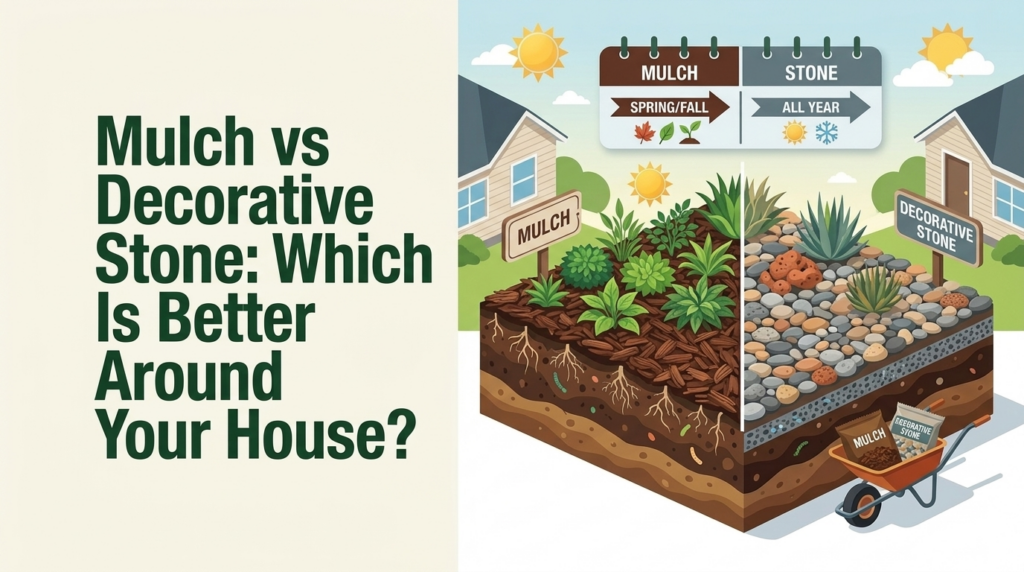
Mulch vs Stone at a Glance
| Factor | Organic Mulch | Decorative Stone |
|---|---|---|
| Soil temperature | Cools soil, moderates extremes | Absorbs and radiates heat, raises soil temperature |
| Moisture retention | Reduces evaporation significantly | Doesn’t retain moisture; can increase heat stress |
| Weed suppression | Strong at correct depth; doesn’t stop perennial weeds | Weakens over time as seeds blow into gaps |
| Soil health | Improves soil as it decomposes | No soil-health benefit |
| Longevity | Breaks down; needs reapplication every 1–2 years | Effectively permanent once installed |
| Upfront cost | Lower material cost | Higher material and installation cost |
| Best for | Beds with trees, shrubs, and perennials | Drainage areas, pathway borders, low-planting zones |
Appearance
Both materials can look excellent, but they create very different visual effects. Fresh mulch gives beds a warm, finished, “just cared for” look, with a rich, uniform color that makes surrounding plants look healthier by contrast — it’s one of the most cost-effective ways to improve curb appeal in a single afternoon. Decorative stone reads as more permanent and architectural, with a clean, structured look that pairs especially well with modern hardscaping or minimalist planting schemes.
The trade-off runs the opposite direction over time. Mulch’s color and texture fade and need refreshing to keep that “just done” look, while stone holds its appearance with far less visual upkeep — right up until organic debris, dust, and stray weeds start accumulating in it, at which point it can look more neglected than mulch ever does, since raking debris out of rock is considerably more work than raking it off the surface of a mulch bed.
Both materials also come in more variety than people expect. Mulch options range from natural double-shredded hardwood to dyed colored mulch for a bolder, more uniform look, giving a lot of flexibility to match a home’s existing color palette. Stone varies just as much — size, shape, and color all change the visual effect, from small, pale pea gravel to larger, darker river rock — so “stone” isn’t really one look any more than “mulch” is.
Upfront Cost
Mulch is almost always the lower-cost option to install, both in material and labor. It’s lighter to move, faster to spread, and doesn’t typically require a fabric underlayment or the heavier-duty edging that helps keep stone contained. Stone costs more on both fronts — the material itself is heavier and pricier per cubic yard equivalent, and installation is more labor-intensive since it usually involves preparing the bed, sometimes installing landscape fabric, setting edging to keep stone from migrating into the lawn, and spreading and leveling a much heavier material.
That upfront gap is the main reason mulch remains the default choice for most residential beds — it’s simply the lower-commitment option, both financially and in terms of how disruptive the installation itself is to existing plantings. A stone installation done right also tends to involve more prep work up front: excavating enough depth so the finished stone layer sits flush rather than mounded, addressing drainage before the stone goes down rather than after, and setting edging that’s substantial enough to actually contain a heavier material over years of mowing and foot traffic nearby. None of that is difficult, but it’s real labor that a mulch installation generally doesn’t require to the same degree.
Long-Term Maintenance
This is where the “stone is low-maintenance” assumption gets more complicated than it first appears. Mulch clearly requires more frequent attention: it breaks down over time and needs reapplication roughly every one to two years to keep suppressing weeds and holding moisture effectively, which is real, recurring work and cost.
Stone is marketed as a “install it once and forget it” solution, but that’s not quite how it plays out. Once in place, stone doesn’t need replacing the way mulch does — but wind-blown soil and organic debris settle into the gaps between stones over time, creating exactly the fine seedbed weed seeds need to germinate. Any landscape fabric underneath the stone also ages: it frays, can become visible or unsightly, and once weeds do root down into stone, their roots intertwine through the rocks in a way that makes them considerably harder to pull than a weed rooted in loose mulch. In practice, stone trades frequent, predictable maintenance (reapplying mulch) for infrequent but often more difficult maintenance (digging embedded debris and deeply rooted weeds out from between rocks).
Moisture Retention
Mulch has a clear, measurable advantage here. As our Benefits of Mulching guide covers in more depth, a 2 to 3 inch layer of quality mulch can reduce water evaporation from the soil by up to 70%, which means plants stay hydrated longer between waterings and irrigation systems don’t have to work as hard through Maryland’s hot, humid summers. That moisture retention also helps buffer soil against the extremes of a variable climate — spring deluges followed by summer dry spells — by holding water during dry stretches rather than letting it evaporate immediately.
Stone doesn’t retain moisture in any comparable way. It sheds water rather than holding it near the root zone, and because it absorbs and radiates heat, it can actually accelerate moisture loss from the soil beneath it during hot weather rather than conserving it. For beds with any planting that needs consistent soil moisture, this is one of the more significant practical differences between the two materials.
Weed Suppression
Neither material is a complete weed solution on its own, but they fail in different ways. A properly applied 2 to 3 inch layer of hardwood mulch is the functional depth for effective weed suppression — less than 2 inches allows too much light through, and more than 3 inches can actually work against you by drying into a loose, friable surface layer that wind-blown weed seeds germinate in readily. Even at the right depth, mulch doesn’t control already-established perennial weeds like nutsedge, ground ivy, or bindweed, which grow up through any depth of mulch from root systems that survive underneath.
Stone has its own version of the same failure mode. The larger gaps between individual stones actually make it easier for weed seeds to find a foothold than a solid layer of fine mulch does, and over time, wind-blown soil and organic debris settling into those gaps creates an ideal seedbed. One crabgrass plant alone can produce 150,000 seeds in a single season, so a landscape bed anywhere near a lawn or open ground has a constant seed supply looking for exactly that kind of opportunity.
The practical takeaway is that neither material replaces an actual weed control plan — they’re one layer of it, not the whole strategy. Bed edging matters for both materials, not just mulch, since grass rhizomes creeping in from an adjacent lawn are a major, ongoing weed source that no amount of surface covering stops on its own. Pre-emergent herbicide timed correctly, applied before either mulch or stone goes down, addresses the germination problem at its actual source rather than relying on the covering material to do that work by itself. Our guide on keeping weeds out of landscape beds covers that full integrated approach — pre-emergent timing, mulch depth, edging, and targeted treatment — that actually works under either material, since surface covering alone was never going to be a complete answer for either one.
Soil Temperature
This is one of the clearest, most consistent differences between the two materials, and it matters more than most homeowners expect. Organic mulch cools the soil and moderates temperature swings, keeping the root zone more stable through both summer heat and winter cold. Stone does close to the opposite: it absorbs and radiates heat, which raises soil temperature and contributes to a small-scale heat-island effect right in the planting bed. For heat-sensitive plants, that difference can genuinely stress root systems during Maryland’s hottest stretches, leaving plants struggling in conditions that feel — from the plant’s perspective — considerably more like a desert than the same bed mulched with organic material would.
That’s a meaningful factor to weigh for any bed with plants that are sensitive to heat stress, and it’s one of the strongest arguments for keeping mulch around anything that isn’t specifically chosen for heat and drought tolerance.
Trees and Shrubs
Mulch is generally the better choice around trees, shrubs, and other perennial plantings, and it’s not a close call. Organic mulch belongs directly on the soil surface around trees and shrubs, where it moderates soil temperature, conserves moisture at the root zone, and — as it slowly decomposes — adds organic matter that improves the soil structure around root systems over time. That decomposition process is particularly valuable in Cecil County’s clay-heavy soils, where added organic matter helps break up compacted clay and improve drainage right where a tree or shrub’s roots actually are. Our Spring Mulching Guide covers timing and technique for getting this right before summer heat arrives, which matters most for exactly this kind of planting.
Stone offers none of that ongoing soil benefit, and the heat and moisture issues described above tend to matter most right where trees and shrubs are already working hardest to establish or maintain a root system. Stone isn’t harmful next to mature, well-established trees, but it’s rarely the better choice immediately around anything still building out its root system.
Drainage Areas
Drainage is one of the few places decorative stone has a real, practical edge — but the advantage depends heavily on how it’s installed. In an area with concentrated water flow — a downspout splash zone, a drainage swale, a low spot that channels runoff during heavy rain — mulch is genuinely a poor fit, since lighter organic material floats and washes away in exactly the kind of storm event Cecil County sees regularly. Loose stone stays in place under that same water flow in a way mulch simply can’t.
The nuance is what’s underneath the stone. Landscape fabric installed beneath a stone bed can end up working against drainage rather than for it: it restricts water and air movement into the soil, and as sediment gets trapped on top of the fabric over time, the whole system becomes less permeable, which can actually increase runoff rather than manage it. For a genuine drainage application — a dry creek bed, a French drain surface, an area designed to move water rather than just look finished — stone without fabric, set over properly graded soil, typically performs better than a fabric-and-stone combination chosen mainly for a tidy appearance.
Where Combining Both Works Well
The two materials aren’t mutually exclusive, and on most properties, the best-performing landscape uses each one where it actually plays to its strengths rather than picking one material for the whole yard. Mulch belongs around trees, shrubs, and perennial beds where soil health, moisture retention, and moderate soil temperature genuinely matter for plant performance. Stone earns its place in drainage-focused areas, along pathway borders, in transition zones next to a patio or walkway, or anywhere a low-maintenance, permanent-looking surface matters more than what’s happening in the soil beneath it.
If stone is part of a broader plan that includes a patio, walkway, or retaining wall, our Hardscaping page covers how we approach those larger structural stone projects — worth a look if decorative stone is one piece of a bigger outdoor living plan rather than a standalone bed treatment. For the planting beds themselves, our Mulch page covers material options and seasonal application for Cecil and Harford County landscapes.
Thinking through a whole property this way, rather than picking one material for every bed, is usually what separates a landscape that looks and performs well in every zone from one that’s using a single material as a compromise everywhere. A front foundation bed full of shrubs, a dry, sloped side yard that channels roof runoff, and a border strip along a front walkway are three different problems, and it’s reasonable for them to have three different answers.
Not sure which material makes sense for a specific bed on your property? Request a free estimate and we’ll walk the site with you rather than guess from a description.