
Once a homeowner decides an irrigation system makes sense, the next question is almost always about irrigation zones — specifically, how many a particular yard actually needs. It’s a reasonable question to have no intuition for, since most people have never had a reason to think about their landscape in terms of independently controlled sections before. The honest answer is that zone count isn’t a fixed number tied to lot size; it’s a function of how many genuinely different watering needs a property has, and how those needs are grouped together. This guide walks through what actually drives that number.
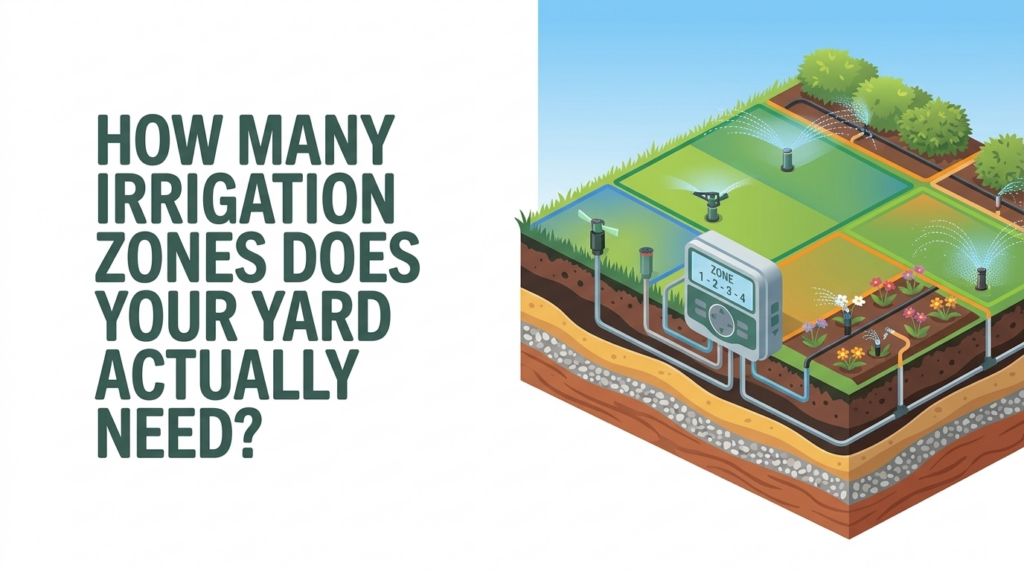
What Is an Irrigation Zone?
An irrigation zone is simply a section of a property that’s watered independently of every other section — its own valve, its own run time, its own schedule, controlled separately from the rest of the system even though it’s all part of one overall setup. Two zones can run at completely different times, for completely different durations, on completely different days, because each one only has to account for what’s actually in it.
That independence is the entire point of zoning. A system with a single zone can only apply one watering pattern to everything connected to it, which works fine if literally everything on that property has the same water needs — an outcome that’s rare on any property with more than a small, uniform patch of lawn.
Why One Zone Can’t Usually Water Everything Correctly
If the same irrigation system serves different types of plants or different areas with different conditions, those areas need to be on different zones to be watered independently and correctly. Turf, shrubs, and shaded versus sunny ground don’t just look different — they draw water at different rates, need different depths, and often benefit from different schedules altogether. Plants also need more frequent, shallower watering when they’re newly planted or less developed, and less frequent, deeper watering once they’re established — which means a young planting bed and a mature one can have opposite needs at the same time, let alone a planting bed and a lawn.
A single zone averages all of that together, which in practice means every area on it gets a compromise: not quite enough for the thirstiest part, more than necessary for the least thirsty part. That’s a big part of why a lawn can look fine in most places and stressed in specific, predictable spots even with a working sprinkler system already in place — the zone boundaries don’t actually match where the real differences in the yard are. A homeowner troubleshooting that kind of pattern often assumes the system itself is broken, when the more common explanation is that it was never zoned to account for the difference in the first place.
Water Pressure and Flow
Zoning isn’t only about matching water to plant needs — it’s also a hard physical constraint. Every property has a finite amount of water pressure and flow available at any given moment, and that flow rate, along with pipe size, determines how much a single zone can realistically run at once. Push too many sprinkler heads onto one zone and the available pressure gets divided across all of them, which shows up as exactly the problems described in our Summer Lawn Watering Myths guide: too little pressure per head causes poor coverage and dry spots, while a system straining to push water through too many outlets at once can create fine misting that loses a disproportionate share to evaporation before it reaches the ground.
This is why bigger or more complex properties need more zones rather than simply more heads crammed onto the same zone — splitting the property up keeps each zone’s head count within what the available pressure and flow can actually support, so every zone gets the pressure it needs to work correctly rather than sharing an inadequate amount with too many other heads.
Lawn Zones
Turf areas are usually the most straightforward part of zone planning, but “the lawn” is rarely just one zone on any property beyond a small, uniform yard. Large, open stretches of turf are typically best served by rotary heads, which throw water further and are built for covering more square footage evenly per head. Smaller or more detailed turf areas — narrow strips, awkward corners, areas broken up by walkways or beds — usually call for spray heads instead, since they’re designed for shorter-throw, more detailed coverage rather than efficiently covering wide open ground.
Beyond head type, a lawn with meaningfully different sun exposure across its area — a front yard in full sun and a shaded side yard, for instance — often needs to be split into separate lawn zones for that reason alone, even before shrubs, beds, or slopes enter the picture at all.
Shrub and Landscape-Bed Zones
Shrubs, foundation plantings, and perennial beds have different watering needs than turf, and mixing them into a lawn zone almost always shortchanges one or the other. Overhead spray or rotary heads are built for turf; tubing and drip-style delivery are generally the better match for perennial plantings, shrubs, and trees, since they deliver water slowly and directly to the root zone rather than broadcasting it across a wider area the way turf irrigation does. That difference in both watering method and schedule is exactly why bed areas are typically their own dedicated zone (or zones) rather than sharing one with adjacent lawn.
Soil type adds another layer to that planning. Sandier soil generally needs more frequent, shorter watering since water moves through it quickly, while loamier soil holds moisture longer and suits less frequent, deeper watering — which means two bed areas with different soil composition can need different schedules even when they’re planted with similar shrubs. That’s one more reason bed zones tend to benefit from being planned individually rather than lumped into a single “everything that isn’t lawn” zone.
We’ll have a full guide on drip irrigation for planting beds — including when it’s worth the extra zone versus running beds on a standard spray zone — coming soon; for now, the short version is that any property with meaningful shrub or bed coverage benefits from planning those areas as their own zone from the start rather than retrofitting it later.
Sunny vs Shaded Areas
Sun exposure changes how fast an area dries out, which changes how often it actually needs water — and that’s true within a single lawn, not just between the lawn and the beds. A full-sun section of turf can need noticeably more frequent watering than a shaded section just a short distance away, and running both on the same zone and schedule means one of them is being watered incorrectly on every single cycle, even if the other looks perfect.
This is one of the zoning decisions that’s easy to miss during a basic installation but makes a real difference over a full season: splitting sun and shade into separate zones lets each one run on the schedule it actually needs, rather than forcing a single compromise setting across both.
The risk of getting it wrong runs in a specific direction, too. Shaded soil already holds moisture longer than soil in full sun simply because it evaporates more slowly, so a shaded zone watered on a full-sun schedule doesn’t just waste water — it tends toward the warm, consistently moist conditions that let turf diseases like brown patch and dollar spot take hold. Splitting sun and shade into separate zones isn’t only about efficiency; it’s often the difference between a shaded lawn area that stays healthy and one that develops recurring disease problems no fungicide schedule fully solves on its own.
Slopes and Drainage
Sloped ground behaves differently under irrigation than flat ground does, and it’s one of the clearer cases for a dedicated zone. Compacted or clay-heavy soil — common throughout Cecil and Harford County — already loses more water to runoff than looser soil does, and slope adds gravity to that same problem: water applied faster than a sloped area can absorb it runs downhill before it ever soaks in, wasting water and leaving the upper part of the slope under-watered even as the base of it stays soggy.
The fix is the same cycle-and-soak approach used for correcting shallow watering generally — running a zone for a shorter interval, pausing to let the applied water actually infiltrate, then running it again until the target depth is reached — but a slope typically needs that approach applied more aggressively than flat ground does. Putting sloped sections on their own zone makes that kind of tailored scheduling possible without forcing the same multi-cycle approach onto flat areas that don’t need it.
Rotor vs Spray vs Drip Zones
Head type is as much a part of zoning as area and plant type, since mixing head types on a single zone rarely works well — different heads apply water at different rates, and a zone with mismatched output ends up over- or under-watering different parts of itself. Rotor heads suit large, open turf areas where throwing water further and covering more ground per head matters most. Spray heads suit smaller, more detailed turf sections where shorter, more precise coverage is the priority. Drip-style delivery suits shrubs, perennial beds, and trees, where slow, direct watering to the root zone beats broadcasting water across foliage and open soil.
Matching zones to head type this way is part of why a well-planned system usually ends up with more zones than someone might guess from lawn size alone — head type is doing as much work in the zone count as square footage is.
The reason mixing head types on one zone causes problems is precipitation rate — the speed at which each head type actually delivers water to the ground. Rotor heads apply water more slowly over a wider area, while spray heads apply it faster over a shorter distance, and drip delivery is slower still. Run all three off the same zone for the same duration and each one is either under- or over-watered relative to what it actually needed, because the zone’s single run time can only be correct for one precipitation rate at a time. Grouping heads by type first, then designing zone boundaries around those groups, avoids that mismatch entirely.
Example Layout for a Typical Property
The table below illustrates how these factors typically combine into a zone plan for a fairly common Cecil County residential layout — a lawn with some sun/shade variation, a sloped side yard, and foundation planting beds. It’s meant as an illustration of the reasoning, not a template to copy onto every property, since every yard’s actual layout changes the specifics.
| Zone | Area | Head Type | Why It’s Separate |
|---|---|---|---|
| 1 | Front lawn, full sun | Rotor | Large open turf, higher water demand from full sun exposure |
| 2 | Back lawn, partial shade | Rotor or spray (by size) | Different sun exposure means a different schedule than Zone 1 |
| 3 | Foundation shrub beds | Drip | Different plant type and watering method than turf |
| 4 | Sloped side yard | Spray, cycle-and-soak schedule | Slope and soil type require shorter, repeated cycles to prevent runoff |
| 5 | Narrow strip / detailed turf area | Spray | Small, irregular area better suited to short-throw coverage than rotor heads |
Five zones for a moderately sized property with some real variety in sun, slope, and planting type is a reasonable illustration — a simpler, uniform lot might need fewer; a larger or more complex property with more distinct planting areas could reasonably need more.
Why Zone Design Matters More Than Zone Count
It’s tempting to treat zone count as the headline number in an irrigation project, but a well-designed system with fewer zones will consistently outperform a poorly planned system with more of them. What actually matters is whether the zone boundaries line up with the real differences on the property — sun versus shade, turf versus beds, flat versus sloped, and what the available pressure and flow can support per zone. Get those boundaries right and even a modest zone count waters every part of the property correctly. Get them wrong and no number of zones fully compensates for a plan that doesn’t match how the property actually behaves.
That’s ultimately a site-specific design question rather than a rule of thumb, which is why it’s worth working through with someone who walks the property rather than guessing from square footage alone. Our Irrigation page has more on how we approach that design process for Cecil and Harford County properties.