
Timing matters more with sod installation in Maryland than most homeowners expect. Sod is already a living lawn the moment it’s unrolled, but it still has to root into the soil beneath it — and how easily that happens depends heavily on the season, the weather, and how much watering the new turf can realistically get. Install at the wrong time of year and even correctly laid sod can struggle to establish; install in the right window and the same sod roots in as little as two to three weeks. This guide walks through how each season affects sod installation in Maryland, so the calendar becomes part of the plan instead of an afterthought.
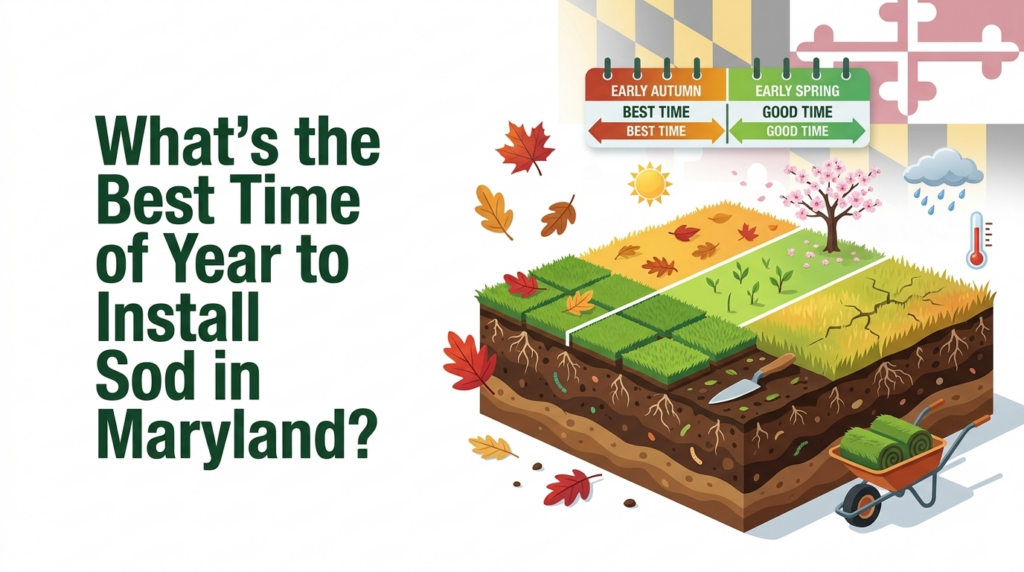
Best Sod Installation Season: Quick Answer
For most of Cecil and Harford County, the best window for sod installation is late summer into late fall — roughly September through November. Cooler air and soil temperatures reduce heat stress on the new sod, rainfall tends to be more consistent than in mid-summer, and the grass has time to root before winter dormancy sets in. Within that broader window, many installations lean toward the earlier end — mid-August through mid-October — since that gives sod the longest possible stretch of good rooting weather before the first hard frost.
That doesn’t mean fall is the only time sod installation works. Spring is a workable secondary option, summer is possible with real caveats, and even late fall has a narrower version of the ideal window. The sections below break down what changes season to season. If you haven’t yet settled on sod over seed in the first place, our sod vs seed comparison is worth reading before locking in a timeline, since the two methods don’t share the same seasonal constraints.
Can Sod Be Installed in Spring?
Yes — spring is a legitimate second option for sod installation in Maryland, and it’s a meaningfully better spring option than seeding is. Sod can generally go down any time the ground isn’t frozen and daytime temperatures stay below 90°F, which covers most of March through May in this region. Because sod arrives as already-established turf rather than something that has to germinate, it skips the single biggest problem spring creates for grass seed: weed competition. Seed sown in early spring has to compete with weeds that are also waking up and growing fast, which is the most common reason spring seeding attempts fail. Sod doesn’t have that vulnerability in the same way, since it arrives dense enough to crowd weeds out from day one.
The trade-off is that spring-installed sod still needs the same disciplined watering as fall-installed sod, but it’s doing that rooting work heading into summer heat rather than heading into cooler fall weather — which raises the stakes if watering gets inconsistent. Our spring lawn care program is built around this exact season, and can help keep a spring sod installation on track through its rooting period.
Summer Sod Installation
Summer is the riskiest season for sod installation in Maryland, and it’s worth postponing when possible. The general guidance is to hold off on installing sod once temperatures reach the high 80s or 90s, since new sod under heat stress dries out fast and has far less margin for error on watering than sod installed in cooler weather. That’s not the same as saying summer installation is impossible — sometimes a project can’t wait, whether because of construction timing, a sale, or bare ground that simply can’t be left exposed through another season. When summer installation is unavoidable, watering has to be treated as non-negotiable rather than a nice-to-have, since a single missed day during a heat wave can undo sod that was otherwise installed correctly.
If a summer timeline is flexible at all, pushing installation even a few weeks toward early fall meaningfully improves the odds of a smooth rooting period without the extra watering burden summer heat creates.
Why Early Fall Is Attractive
Early fall is where Maryland’s climate and cool-season turf’s biology line up best, which is why it’s the season most sod installation — and most seeding — gets scheduled around. Soil and air temperatures in this window support strong root development without the heat stress that makes summer installation risky, and rainfall in a typical Maryland fall tends to be more consistent than the mid-summer stretch, reducing how much of the watering burden falls entirely on hoses and irrigation. Installing early in the fall window, rather than waiting until late October or November, also builds in a buffer: the more weeks of good root-growing weather sod gets before winter dormancy, the more resilient it is heading into the following summer.
This is the same logic behind timing fall lawn programs generally — cooler temperatures and active root growth aren’t unique to sod, they’re the reason fall works well for lawn care broadly. Our fall lawn care program is built around this same seasonal window, whether the goal is new sod, overseeding, or general lawn recovery.
Can Sod Be Installed Late in the Year?
Sod’s fall window is more forgiving on the back end than seed’s is, since sod doesn’t need to germinate before a killing frost the way seed does — it just needs enough time to root before hard winter sets in. That gives sod some flexibility into November that seed doesn’t really have. Winter installation, though, is a different situation: sodding during winter can succeed, but it’s genuinely risky because of winter injury and desiccation — cold, drying winds and freeze-thaw cycles can damage sod that hasn’t had time to root before the coldest part of the year arrives.
In practice, that means late fall (into November) is a reasonable extension of the ideal window when an early-fall installation isn’t possible, but pushing installation into December or later starts trading a meaningful amount of reliability for convenience. If a project is landing that late in the year, spring becomes the more sensible fallback rather than forcing a winter installation.
Soil Preparation Matters More Than the Calendar
Timing sets the odds, but soil preparation is what actually determines whether sod roots well once it’s down — and it matters in every season, not just the risky ones. A soil test before starting tells you whether pH and nutrient levels need correcting, which is far easier to fix before sod goes down than after. The planting area should be prepared in advance of delivery and lightly moistened with water right before installation, so the sod is meeting soil that’s ready to receive it rather than dry, compacted ground.
Sod itself is a perishable product, which is a preparation detail that’s easy to overlook. It should be installed immediately after delivery, especially in hot or dry weather, and if installation has to be delayed a day or two, it needs to be stored flat, grass-side up, in a cool, shaded area so it doesn’t dry out or heat up while still rolled. Quality sod at delivery should be evenly moist without being soaking wet, with roots roughly a half-inch to three-quarters of an inch thick — thin, dried-looking sod at delivery is a sign something went wrong before it ever reached the yard.
How Weather Changes the Watering Schedule
Every sod installation needs water immediately after it goes down, and needs it consistently through the rooting period — but how often that translates to in practice depends heavily on the weather during that specific window. The core rule doesn’t change with season: water the sod immediately after installation to moisten the soil beneath it without overwatering, and never let the sod dry out during establishment. What changes is how much daily watering is required to meet that standard.
A sod installation rooting through late-summer heat is fighting faster evaporation and higher plant water demand, so daily watering isn’t optional — it’s often the minimum needed to prevent the sod from drying out between waterings. A fall installation rooting through cooler, wetter weather has more margin; natural rainfall does more of the work, and the soil holds moisture longer between waterings. That’s a large part of why fall installations are more forgiving of an inconsistent watering schedule than summer ones are — the season itself is doing some of the work that would otherwise fall entirely on a hose or irrigation system.
Time of day matters as much as frequency. University of Maryland Extension recommends watering in the early morning, before 10 a.m., specifically to minimize how long the grass stays wet — wet turf sitting through a hot afternoon or overnight is exactly the condition that promotes disease. That guidance holds in every season, but it matters most in summer, when afternoon watering has the added downside of a meaningful share evaporating before it ever reaches the roots.
New sod, newly seeded lawns, and any lawn under two years old need consistent irrigation and should be watched for the same drought-stress signs regardless of season: an off-color or blue-gray appearance, leaf blades that look smaller than normal or begin to wilt, and grass that doesn’t bounce back after a footprint is left on it. Catching those signs early — and increasing watering in response — is often the difference between sod that struggles through a rough stretch of weather and sod that fails outright.
How Long Before You Can Walk or Mow It?
New sod typically roots into the soil beneath it in about two to three weeks, and the practical rule during that window is simple: stay off the sod until it has rooted. Foot traffic, pets, and mowing equipment can all lift or shift sod that looks fully settled on the surface but hasn’t actually anchored into the ground yet, which can undo weeks of otherwise successful establishment in a single afternoon.
Once that rooting window has passed and the sod can be mowed for the first time, our guide to tall fescue mowing height in Maryland covers the cutting height new sod should be maintained at going forward, since mowing too short too early puts unnecessary stress on turf that’s still finishing its first season of establishment.
Sod Installation FAQs
What is the best month to install sod in Maryland? September through October is generally the strongest window, with the broader fall season — roughly September through November — remaining a good option. This gives sod the most reliable combination of cool temperatures, consistent rainfall, and enough time to root before winter.
Can you install sod in the summer in Maryland? It’s possible, but it’s the riskiest season to do it in. Installation is generally best postponed once temperatures reach the high 80s or 90s, and if summer installation can’t be avoided, daily watering typically becomes necessary to keep the sod from drying out.
Can sod be installed in winter? It can be attempted, but winter sodding is risky due to winter injury and desiccation from cold, drying conditions. Late fall, rather than winter, is the more reliable way to extend past the ideal early-fall window.
Is spring a good time for sod installation in Cecil County? Yes — spring is a solid secondary option. Sod can generally be installed any time the ground isn’t frozen and daytime temperatures stay below 90°F, and unlike spring seeding, it isn’t set back by spring weed competition the way seed is.
How long does it take new sod to root? Roughly two to three weeks under normal conditions, though that timeline can stretch in unfavorable weather or shrink slightly in ideal fall conditions.
How soon can I walk on or mow new sod? Stay off new sod entirely until it has rooted, generally the same two-to-three-week window. Walking, pet traffic, or mowing before that point can shift sod that hasn’t anchored into the soil yet.
What time of day should I water new sod? Early morning, ideally before 10 a.m. Watering earlier in the day minimizes how long the grass stays wet, since wet turf sitting through the afternoon or overnight promotes disease — a factor that applies in every season but matters most in summer heat.
How can I tell if new sod isn’t getting enough water? Watch for an off-color or blue-gray appearance, leaf blades that look smaller than normal or begin to wilt, and grass that doesn’t spring back up after a footprint is left on it. Any of those signs means it’s time to increase watering rather than wait it out.
Not sure whether the timing works for a sod project on your property, or whether sod is even the right call versus seed? Request a free estimate and we’ll walk the site with you and build a realistic installation timeline around it.