
Brown grass near driveway edges and sidewalks is one of the most consistent complaints Cecil County homeowners have every summer, and it’s also one of the most misdiagnosed. The rest of the lawn can look genuinely healthy while a strip along the concrete stays scorched no matter how much water or fertilizer it gets, and that pattern alone usually rules out the causes homeowners jump to first — disease, poor soil everywhere, or a fertilizer problem. Brown lawn edges almost always trace back to something specific to that strip of ground, not the yard as a whole.
This guide walks through the five real causes, how to tell them apart, and what actually fixes each one.
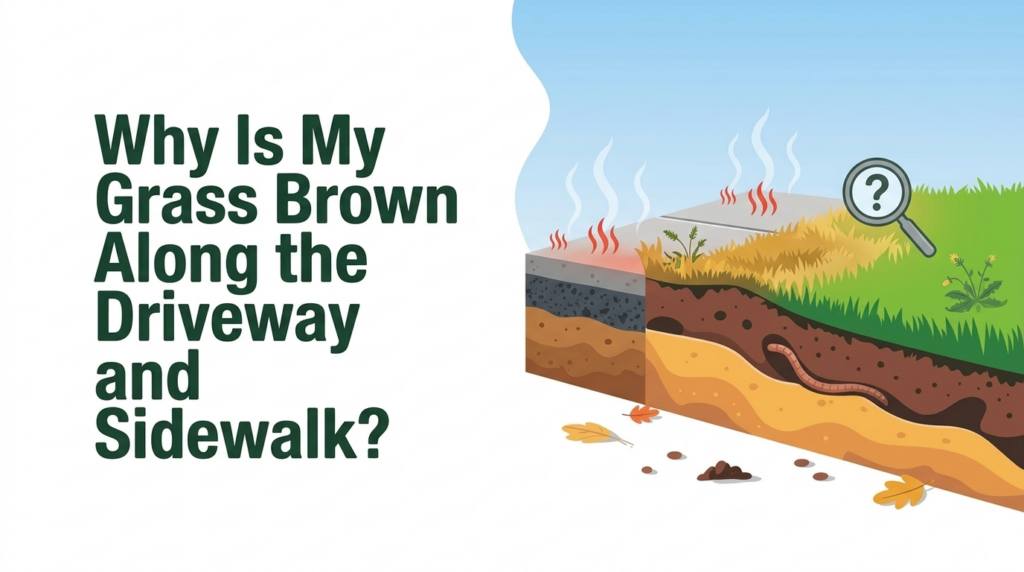
Why Grass Beside Concrete Browns First
Grass growing next to a driveway or sidewalk deals with a different, harder set of conditions than grass in the middle of the yard, and it deals with them every single day of the growing season. It’s hotter there. The soil is often thinner and worse. It’s easier to under-water accidentally. And it’s more exposed to mower and trimmer damage, plus, in winter, salt. None of these problems affect the rest of the lawn, which is exactly why the edge fails first and most visibly — it’s not weaker grass, it’s grass working under worse conditions.
Heat Reflection and Soil Temperature
Concrete and asphalt absorb heat throughout the day and radiate it back out, and grass growing within a foot or two of that surface takes the brunt of it. Thermal imaging studies of residential lawns have documented measurably higher heat stress in turf immediately next to a driveway compared to grass even a short distance away — the strip along the hardscape runs hotter, stays hotter longer into the evening, and loses moisture faster than the rest of the yard under identical watering.
This effect compounds with everything else on this list. A lawn edge that’s already running hotter than the rest of the yard has less margin for a missed watering, a skipped mow at the right height, or any other stress — which is part of why the same strip tends to brown out first and recover last every single summer.
Shallow Soil Along Driveway Edges
Soil quality right along a driveway or sidewalk is often genuinely worse than soil a few feet into the lawn, and it usually traces back to how the hardscape was built. Construction activity compacts and disturbs soil along the edge of a driveway during installation, and it’s common for the final grading to leave a thinner, lower-quality layer of topsoil right at that border compared to the rest of the yard. Grass planted into that zone is starting with a smaller root volume and lower moisture-holding capacity before heat or traffic ever become factors.
This is also why simply watering the edge more doesn’t always solve the problem on its own — shallow, degraded soil has less capacity to hold that water once it’s applied, so the same watering schedule that keeps the rest of the lawn green can still leave the edge struggling.
Irrigation Coverage Gaps
For homes with an irrigation system, uneven coverage along the edges of the lawn is one of the most common and most overlooked causes of a brown strip near the driveway. Sprinkler heads get knocked out of alignment by mowers, foot traffic, and normal settling over time, and head-to-head coverage gaps tend to show up first at the perimeter of a zone — exactly where the lawn meets the driveway or sidewalk. A zone that looks like it’s watering the whole yard can still be leaving the outer few feet under-watered every single cycle without that gap being obvious from a quick glance.
This is a case where the actual cause is frequently misdiagnosed. A stressed strip along a driveway gets blamed on soil quality or shade far more often than on the irrigation system itself, when a misaligned or worn head is the real issue. If you have an irrigation system and the brown strip follows the edge of a zone precisely, that’s a strong signal to check head alignment and coverage before assuming a soil or heat problem.
Salt and Winter De-Icer Damage
If the brown strip along a driveway or sidewalk shows up every spring in roughly the same spot, winter de-icer is worth ruling out before anything else. Rock salt — sodium chloride — damages turf two ways: it burns grass tissue on direct contact during application, and in areas with poor drainage, sodium builds up in the soil over time, competing with grass roots for water and, at high enough concentrations, degrading the soil’s physical structure to the point that it becomes genuinely inhospitable to plant growth.
The damage doesn’t always show up immediately. Salt applied in January can leave soil carrying a residue that isn’t obvious until the grass tries to green up in spring and the same strip along the walkway comes back thin, brown, or bare while the rest of the lawn recovers normally. Calcium magnesium acetate is a meaningfully less damaging de-icing option than rock salt, though it costs more, and calcium chloride or magnesium chloride products are somewhat gentler on turf than straight sodium chloride if a lower-cost option is needed. Using any de-icer sparingly, and relying on shoveling or plowing as the first line of snow and ice management rather than salt, meaningfully reduces the damage that shows up the following spring. Applying an eco-friendly de-icing product as part of a managed snow removal plan, rather than repeated homeowner applications of straight rock salt, is one of the more overlooked ways to prevent this exact problem before it starts.
Scalping From Mowers and Trimmers
The edge of the lawn along a driveway or sidewalk gets cut twice — once by the mower deck, and again by a string trimmer cleaning up the line the mower can’t reach. That second pass is where most edge scalping happens. Trimmers are easy to run lower than the mower’s deck height, and it’s common for that strip to end up cut noticeably shorter than the rest of the lawn without anyone intending it that way.
The consequences are the same ones that show up anywhere grass gets scalped: less leaf surface to shade the soil, faster moisture loss, and a weaker root system feeding that section of turf. Combined with the heat reflection already hitting that strip harder than the rest of the yard, a scalped edge along the driveway is dealing with two compounding stresses at once, which is a large part of why it’s often the first visibly brown section of an otherwise healthy lawn.
Professionally managed lawn mowing avoids this by treating edging as a height-matched pass rather than a lower, separate cut — the trimmer follows the same target height as the mower deck rather than an arbitrary lower setting, which removes one of the five causes entirely rather than just managing around it.
How to Diagnose the Actual Cause
Because these five causes often overlap, the fastest way to narrow down what’s actually happening is to look at the pattern, not just the color:
- Runs along the entire edge, worst closest to the pavement, fading a foot or two out — points toward heat reflection and shallow soil working together, especially if it’s consistent on every side of the driveway regardless of sun exposure.
- Follows the shape of a sprinkler zone, worse at the far end from the head — points toward an irrigation coverage gap rather than heat or soil.
- Shows up in roughly the same spot every spring, right along a walkway edge — points toward salt or de-icer residue from winter.
- Noticeably shorter grass right at the edge compared to a few feet into the lawn — points toward trimmer scalping.
- Present on a shaded side of the driveway as much as the sunny side — argues against heat reflection as the primary cause and points more toward soil, irrigation, or salt.
Checking more than one of these patterns against the actual site is worth the extra few minutes, since it’s common for two causes — shallow soil plus heat reflection, or scalping plus an irrigation gap — to be compounding each other in the same strip.
It’s also worth ruling out disease before settling on one of the five causes above, since the two can look similar at a glance but call for different fixes. Disease and general drought stress tend to show up differently than edge-specific browning: drought stress across the wider lawn is usually more uniform and develops gradually, with the grass still rooted in place, while fungal issues like brown patch — common in Cecil County during hot, humid summers — tend to show up as irregular circular patches where the grass pulls away from the soil easily and the problem spreads within days rather than staying fixed to one strip along the concrete. A brown zone that’s confined tightly to the edge of the driveway and stable in shape from week to week is almost always one of the five causes above, not disease.
Repairing Brown Lawn Edges
Repair only works once the actual cause has been addressed — reseeding a strip that’s still getting scalped every week, or still sitting under a coverage gap, produces the same result again within a month. Once the underlying cause is fixed:
- For heat and soil-related browning, topdressing with quality soil or compost before overseeding gives new grass a better root environment than reseeding directly into thin, degraded edge soil.
- For irrigation gaps, correct head alignment or add supplemental coverage before reseeding, and confirm the fix with a container test — placing a few catch cups along the edge during a normal cycle — rather than assuming a head adjustment solved it.
- For salt damage, flushing the affected soil with water in early spring before planting helps move residual sodium out of the root zone, since grass seed germinating directly into salt-affected soil will struggle regardless of how good the seed is.
- For scalped edges, simply raising the trimmer to match mower deck height going forward is often enough on its own, without any reseeding needed, once the strip gets a full growing season without being cut short again.
In every case, patch seeding a narrow edge strip needs the same basic conditions as any other overseeding project — the right seed for the existing lawn, consistent watering during germination, and a fall timing window when possible for the best odds of the new grass actually taking.
Preventing the Problem Next Summer
A brown edge that gets fixed once but not addressed at the cause tends to come back the following year on the same schedule. A few habits prevent that:
- Inspect irrigation heads at the start of each season, particularly ones positioned near the edges of zones, where coverage gaps are most likely to develop. A quick catch-cup check of actual watering depth along the driveway edge specifically, not just the middle of the lawn, catches gaps before they show up as brown grass.
- Set the trimmer to match the mower’s deck height, rather than trimming edges shorter out of habit.
- Choose a lower-sodium de-icer, or skip salt in favor of manual clearing, especially on the section of walkway closest to lawn areas that already struggle each year.
- Topdress and overseed problem edges in fall, when new grass has the best chance to establish before next summer’s heat puts the same strip under stress again.
None of these are large projects individually, but together they’re the difference between an edge that browns out every single summer and one that finally holds up.
Brown Grass Near Driveway: Diagnostic Table
| Appearance | Likely Cause | Correction |
|---|---|---|
| Uniform browning along the entire edge, worst nearest the pavement | Heat reflection + shallow construction soil | Topdress with quality soil/compost, then overseed in fall |
| Brown strip follows one sprinkler zone, worse at the far end | Irrigation coverage gap | Realign or add heads; confirm coverage with a catch-cup test |
| Same spot browns every spring near a walkway | Salt/de-icer residue | Flush soil in early spring; switch to a lower-sodium de-icer or shovel instead |
| Grass visibly shorter right at the edge than a few feet in | Trimmer scalping | Match trimmer height to mower deck height going forward |
| Browning present on shaded side of driveway too | Soil, irrigation, or salt (heat reflection unlikely) | Rule out heat first, then check irrigation coverage and salt exposure |
Not sure which of these is causing your brown edge? Request a free estimate and we’ll diagnose it on site rather than guess from a description. For lawns already dealing with dry patches beyond just the driveway edge, our guide on diagnosing sprinkler dry spots covers coverage-gap troubleshooting in more depth. (Note: confirm this is the final published URL before linking live — Article #15 wasn’t published at the time this was written.)