
Shrub pruning Maryland homeowners get right on the first try is rarer than it should be, mostly because the correct timing isn’t the same for every shrub — it depends entirely on when that specific plant blooms and what kind of wood it blooms on. Prune the wrong shrub at the wrong time and the consequences aren’t subtle: a lilac that skips its entire bloom season, a hydrangea that never flowers despite looking healthy, a hedge that thins out from the inside because it was sheared into the wrong shape for years. This calendar breaks Maryland shrub pruning down by category, so the timing question has a clear answer for whatever’s actually growing in a specific yard.
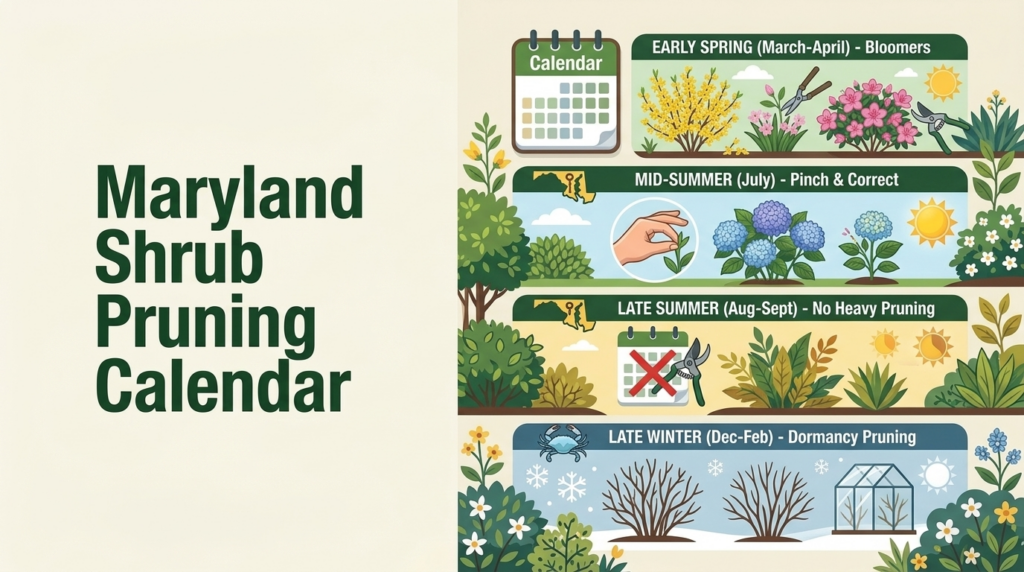
Maryland Shrub Pruning Calendar at a Glance
| Timing Window | What to Prune | What to Avoid |
|---|---|---|
| Dormant season (Dec–early Mar) | Summer-flowering shrubs (butterfly bush, rose of sharon, caryopteris, crape myrtle); hedge renewal cuts; structural pruning | Spring-flowering shrubs — this removes the season’s flower buds |
| Early spring (Feb–Mar) | Severe/renewal pruning of tolerant evergreens (yews, junipers, arborvitae); finishing any remaining dormant pruning | Waiting past bud break on summer-bloomers |
| Immediately after bloom (roughly late Apr–mid May) | Spring-flowering shrubs (azaleas, forsythia, rhododendrons, weigela, lilac) | Pruning spring-bloomers before or more than 4–6 weeks after they finish blooming |
| Late spring–early summer | Light shaping, deadheading, light hedge maintenance | Heavy renewal cuts outside dormant season |
| Late summer–early fall (through Aug) | Corrective pruning only — dead, damaged, or diseased growth | Starting general shaping or renewal pruning |
| True fall (Sept–Nov) | Dead/damaged/diseased removal only | Any pruning that stimulates new growth — it won’t harden off before frost |
Why Bloom Time Determines Pruning Time
The single fact that explains almost every shrub pruning timing rule is whether a shrub blooms on old wood or new wood. Old-wood bloomers set next year’s flower buds shortly after this year’s blooms fade, which means those buds are already on the plant, dormant, through fall and winter — prune at the wrong time and you cut the very buds that were going to flower. New-wood bloomers do the opposite: they form flower buds on growth produced earlier that same season, so pruning before that growth starts doesn’t remove any flowers at all, and can actually encourage the vigorous new growth that produces a heavier bloom.
That single distinction is why “when should I prune my shrubs” doesn’t have one answer — it has as many answers as there are bloom-timing categories, and getting it backwards produces the most common and most visible shrub pruning mistake homeowners make.
Figuring out which category a given shrub falls into doesn’t require guesswork. Our Spring Cleanup Checklist walks through this same old-wood/new-wood distinction as part of the broader spring task list for Cecil and Harford County properties, and it’s worth checking a plant’s status there before making the first cut of the season — especially on a shrub that isn’t one of the common examples covered directly on this page.
Late-Winter Pruning
Late winter — while plants are still dormant and before new growth initiates — is the correct window for anything that blooms on new wood, since pruning here doesn’t remove any flower buds and instead sets up vigorous spring growth that the flowers will form on. Summer-blooming shrubs like butterfly bush, rose of sharon, and caryopteris fall into this category, and many of them respond well to fairly aggressive cutting back at this time — butterfly bush in particular benefits from being cut back close to the ground annually rather than lightly trimmed.
This is also the window for structural or renewal pruning generally, on shrubs where that’s appropriate, and it overlaps with when many trees get their dormant-season pruning too, since bare branches make structure easy to see and most trees aren’t actively pushing sap at this point in the year (maples and birches specifically bleed heavily if cut later in spring, which is part of why late winter is the preferred window for them as well).
Spring-Flowering Shrubs
Azaleas, forsythia, rhododendrons, weigela, and lilac all bloom on old wood — growth set the previous season — which means they need to be pruned immediately after they finish flowering, not before and not too long after. The practical window runs roughly late April through mid-May, shifting earlier or later depending on the specific species and how the season is running. Prune before bloom and this year’s flower display gets removed along with the branches. Wait more than about four to six weeks after blooming ends and there’s a real risk of cutting into the new buds that plant has already started setting for next year, which means a missed bloom season isn’t limited to the year you pruned incorrectly — it can carry into the following year too.
This is also the category where “watch the plant, not the calendar” matters most. A fixed date doesn’t account for how early or late a given spring is running, so the real signal is the shrub finishing its bloom, not a specific week on paper.
Summer-Flowering Shrubs
Butterfly bush, rose of sharon, caryopteris, and crape myrtle all bloom on new wood — growth produced earlier in the same season — so the correct timing is the opposite of spring-blooming shrubs: prune in late winter or early spring, before growth initiates, rather than after flowering. Many respond well to fairly aggressive cutting back at this time specifically because it’s what generates the vigorous new growth that produces heavy summer flowering.
Technique matters as much as timing within this category, and crape myrtle is the clearest example. Topping a crape myrtle — cutting main stems back to stubs, sometimes called “crape murder” — is a common and highly visible mistake across Maryland landscapes, and it’s not a matter of timing at all; it’s simply the wrong technique for that species regardless of when it’s done. Correct pruning for crape myrtle is selective, not a uniform top-cut, which is a meaningfully different skill than the more forgiving, cut-it-back-hard approach that works fine on butterfly bush.
Evergreen Shrubs
Evergreens follow a different rule than either flowering-shrub category, and it’s one that’s easy to get wrong in the other direction: don’t cut evergreen branches back into old wood, since many evergreens won’t regenerate new growth from bare, leafless wood the way deciduous shrubs will. Some genera are the exception and tolerate severe pruning well — yews, junipers, hemlocks, false-cypress, and arborvitae can all be headed back significantly — but even for those, the right timing for a severe cutback is early spring, not the middle of the growing season or heading into fall.
For evergreens outside that tolerant group, lighter, more conservative shaping that stays within the plant’s existing green growth is the safer approach at any time of year, since a cut into bare interior wood on an intolerant species can leave a permanent gap that never fills back in.
Broadleaf evergreens — boxwood and holly are the two most common on Maryland properties — follow a related but distinct concern from needled evergreens like yew and juniper. Boxwood tolerates renewal pruning reasonably well, but repeated shearing at the same outer line year after year creates a thin shell of green growth over a hollow, leafless interior, since sunlight never reaches the plant’s center to sustain foliage there. Occasional thinning cuts that open small gaps in that outer shell let light reach further into the plant and keep growth from being limited to just the outer few inches. Holly responds to shearing overuse in a similar way, and both hold up better long-term with some hand-pruning cuts worked in alongside routine shearing rather than shearing alone, season after season.
Hedges
Formal hedges have their own establishment and maintenance rhythm, separate from how individual shrubs of the same species might otherwise be pruned. Young hedge plants, one to three years old, are typically cut back hard at planting — down to roughly three to five inches above the ground — specifically to force dense branching low on the plant rather than letting it grow tall and thin at the base first. Established hedges benefit from an annual renewal cut before spring growth begins, removing roughly a quarter to a third of the oldest branches near ground level, which keeps the hedge regenerating from the bottom instead of thinning out there over time.
Shape matters more for hedges than for almost any other pruned shrub, because a hedge’s cross-section directly determines whether its lower branches get enough light to stay dense. A hedge that’s wider at the base and narrower at the top — a narrow pyramid, essentially, sometimes with a slightly rounded or pointed crown that also helps shed snow — lets light reach the lower branches and keeps growth full from top to bottom. A hedge sheared into a rectangle or, worse, wider at the top than the base shades its own lower branches, which produces exactly the thin, leggy, hollowed-out-looking growth near the ground that’s common on badly maintained hedges. As a rough proportion, a five-foot hedge might run three and a half to four feet wide at the base, tapering to about a foot wide at the top.
Maintenance shearing frequency depends on how formal the hedge needs to look. A tightly formal hedge line might need shearing two or three times over a single growing season to hold a crisp shape, while an informal or naturalistic hedge often looks better with just one shaping cut a year, or none at all beyond the annual renewal cut. Whichever approach is used, letting the top grow slightly ahead of a hard, flat plane — rather than shearing every new flush of growth back to exactly the same line every time — helps avoid the thin, twiggy surface growth that a hedge sheared too tightly, too often, tends to develop over several seasons.
Dead, Damaged or Diseased Growth
This is the one category where the calendar above doesn’t apply the same way: removing dead, damaged, or diseased branches is appropriate any time of year, regardless of a shrub’s bloom-time category or the season. Leaving that kind of growth in place doesn’t wait for a convenient pruning window — it’s an ongoing entry point for disease and pests, and on larger woody material it can be a genuine safety hazard. The one real exception worth knowing, even though it’s tree-specific rather than shrub-specific: oaks should not be pruned between April and October in Maryland at all, including for storm damage where it can be avoided, since fresh wounds during that window attract the beetles that transmit oak wilt disease. For shrubs generally, though, dead and diseased wood removal is the standing exception to every other timing rule on this page.
Tool sanitation matters more in this category than in routine seasonal pruning, since cuts into diseased wood are exactly the situation where pruning tools can carry infection from one branch, or one plant, to the next. Wiping blades with rubbing alcohol or a diluted bleach solution between cuts on visibly diseased material — and especially before moving on to a different plant — keeps a single infected branch from turning into a property-wide problem.
What Not to Prune in Fall
True fall — September through November — is the wrong season for general or renewal shrub pruning, and it’s worth being direct about why: pruning stimulates new growth, and new growth produced that late in the year doesn’t have time to harden off before frost arrives, which means it’s likely to be damaged or killed over winter regardless of how healthy the shrub otherwise is. Late summer and early fall, roughly through August, is the last reasonable window for corrective pruning — dead or damaged wood, light cleanup — specifically because it’s early enough that any resulting new growth still has time to harden off before the season turns. Our Fall Lawn Care Preparation guide covers this same timing logic as part of the broader fall preparation picture, alongside mulch refresh and lawn care tasks that are timed around the same seasonal cutoff.
The shrubs that get pruned incorrectly in fall most often are the ones people assume are “due” simply because the growing season is winding down — but winding down is exactly why fall pruning backfires. The correct move for most shrubs heading into fall is to leave them alone and wait for the appropriate dormant or post-bloom window instead.
When Professional Pruning Makes Sense
Some of this calendar is straightforward enough to manage with a basic understanding of a shrub’s bloom category, but a few situations are genuinely easier to get right with professional help: a landscape with a wide mix of species where every plant seems to be on a different clock, a hedge that’s already thinned out from years of incorrect shape and needs a renewal strategy rather than a routine trim, or any pruning near trees where species-specific risk — like the oak wilt timing window — has real consequences if missed. Hydrangeas deserve their own mention here too: the old-wood-versus-new-wood question gets more complicated within that single genus than almost anywhere else in the landscape, different hydrangea types follow different rules entirely, and we’ll have a dedicated guide on hydrangea pruning specifically to cover that in the depth it deserves.
Our Plant Pruning service is built around exactly this kind of species-specific timing knowledge — matching the right technique and the right season to each plant rather than applying one approach to an entire property. Our Tree & Shrub Pruning guide covers the broader philosophy behind our approach, including how we handle everything from routine seasonal maintenance to correcting years of incorrect pruning.
Not sure which category a specific shrub on your property falls into? Request a free estimate and we’ll walk the property with you rather than guess from a description.