
Mulch around trees is supposed to help — moderating soil temperature, holding moisture, and protecting roots from mower and trimmer damage — but the most common way homeowners apply it does close to the opposite. Piling mulch up against a tree’s trunk in a cone-shaped mound, often called a mulch volcano, is one of the most visible landscaping mistakes in Cecil County, and it’s also one of the most damaging things a well-intentioned homeowner can do to a tree. The frustrating part is that it’s rarely neglect — it’s usually the opposite, someone making a genuine annual effort to take care of their trees, just applying that effort in a shape that works against the tree rather than for it. Getting tree mulching right isn’t complicated once you know the actual mechanics of why the volcano shape causes problems — and how the correct alternative genuinely protects the tree instead.
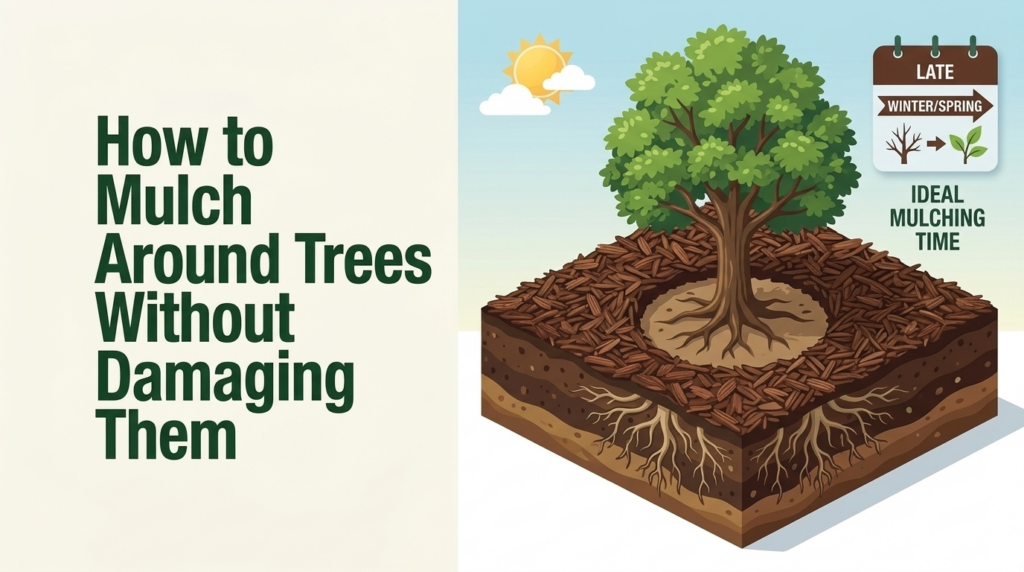
The Correct Way to Mulch Around a Tree
Correct tree mulching forms a flat, even ring — sometimes called a donut shape — rather than a mound against the trunk. Mulch should sit at a consistent two to three inch depth, kept at least three inches away from the trunk itself, and extended outward toward the tree’s drip line where practical, since that’s roughly where the bulk of a tree’s active feeder roots are doing their work. Done this way, mulch still delivers everything it’s supposed to: moderating soil temperature swings, holding moisture at the root zone, and creating a buffer that keeps mowers and string trimmers away from bark that’s easily damaged by direct contact.
The shape matters as much as the depth. A flat ring lets air and light reach the trunk base and keeps the root flare — the point where the trunk widens out at the base, roughly the shape of the base of a wine glass — visible and exposed, the way it’s supposed to be.
What Is a Mulch Volcano?
A mulch volcano is exactly what it sounds like: mulch piled into a cone or mound directly against a tree’s trunk, often a foot or more deep at the base, tapering up the bark several inches or more. It’s an extremely common sight throughout residential Cecil County properties, usually the result of good intentions applied incorrectly — a homeowner or crew adding a fresh layer of mulch around a tree every year without removing what’s already there, and piling it up against the trunk because that’s where it’s easiest to dump and spread from.
It looks tidy and finished, which is part of why it’s so persistent as a practice. The actual effect on the tree underneath that neat-looking mound is a different story.
Why Mulch Against Bark Causes Problems
Mulch piled against a trunk keeps the bark constantly moist in a way tree bark isn’t built to tolerate, which causes decay and creates entry points for disease and insects that healthy, dry bark would otherwise resist. Beneath the surface, excessive mulch reduces the oxygen available to roots, effectively suffocating them — and roots searching for that missing oxygen and moisture sometimes grow directly up into the mulch layer itself rather than staying in the soil, which becomes its own trap: during a dry stretch, that mulch dries out fast, and the roots that migrated into it die along with it.
There’s also a less obvious risk: excess mulch piled against a trunk provides ideal cover for voles, rodents that gnaw on bark and can girdle the trunk and lower stems of trees and shrubs, doing damage that’s often misattributed to disease. A vole tunneling and feeding under a thick mulch mound is essentially invisible until the damage to the bark underneath is already done, which is part of why this particular risk catches so many homeowners off guard — there’s no obvious sign at the surface that anything is happening below it. And the insulating effect of a thick mulch pile can throw off a tree’s normal seasonal signals, delaying fall dormancy or interfering with the temperature cues that trigger spring growth, since the soil and root zone underneath a deep pile simply doesn’t experience the same temperature swings the rest of the landscape does.
None of these problems are visible from a quick glance at a neatly mulched-looking mound — they’re all happening at or below the bark and soil line, which is exactly why volcano mulching does so much damage before anyone notices something’s wrong. A tree can carry a volcano for several years, looking outwardly fine, before the cumulative bark decay, root loss, or girdling roots finally show up as a visible decline that gets blamed on drought, disease, or old age rather than the mulch itself.
How Deep Should Tree Mulch Be?
The same two-to-three inch standard that applies to any landscape bed applies to trees, and it shouldn’t exceed three inches under any circumstances — mulch depth around trees is not a case where more is better or even neutral. We cover the full logic behind that depth range, including how it applies across different bed types and how to measure what’s already there before adding more, in our companion piece on proper mulch depth. (⚠️ That companion content currently lives as an expanded section within your Spring Mulching Guide rather than its own URL — see the note in the metadata below on how this link should ultimately point, depending on whether it ends up standalone.)
How Wide Should the Mulched Area Be?
Width matters in two directions from the trunk outward. Immediately around the trunk, keep a clear, mulch-free buffer of at least three inches — some guidance recommends leaving as much as a foot bare directly around the base for maximum protection — so bark stays dry and the root flare stays visible. From there outward, extending the mulched ring toward the tree’s drip line, rather than stopping in a tight circle a foot or two out, puts the mulch’s moisture and temperature benefits where the tree’s active roots are actually working, rather than concentrating it uselessly close to a trunk that doesn’t want it there in the first place.
A wider, flatter ring also happens to look more deliberate and finished than either a tight circle or a mounded volcano — the mulching approach that’s healthiest for the tree and the one that looks most professional turn out to be the same approach. For trees planted close together, or near a foundation, patio, or walkway where the drip line runs past a hardscape edge, the ring simply stops at that boundary rather than trying to force the full radius — some coverage toward the drip line is better than none, even when the full ideal width isn’t physically available.
Should Landscape Fabric Go Under Tree Mulch?
Generally, no — landscape fabric under mulch around a tree tends to work against the tree over time rather than for it. Fabric restricts water and air movement into the soil, and as sediment and organic debris collect on top of it, it becomes progressively less permeable, reducing water infiltration right where a tree’s roots need it most. It also interferes with one of organic mulch’s real benefits — gradually breaking down and feeding organic matter into the soil — since fabric blocks that material from ever reaching the ground underneath it. For a tree specifically, where root health and soil oxygen already matter more than in an open bed, skipping the fabric and relying on correct mulch depth and shape to manage weeds is generally the better long-term choice.
What to Do With Existing Volcano Mulch
Fixing an existing volcano starts with finding the root flare, which is often buried under years of accumulated material and requires careful excavation to locate — not just raking the surface, but working down to where the trunk actually widens out at the base. Once the flare is exposed, it’s worth checking for stem girdling roots: roots that have started growing around the trunk instead of outward away from it, a problem that develops specifically because a buried flare hides it from view until it’s already compressing the tissue that moves water and nutrients through the tree. Symptoms of an established girdling-root problem include leaf yellowing, smaller-than-normal leaves, leaf scorch, branch dieback, and cracking bark near the base — signs that are easy to blame on drought or disease when the actual cause is sitting right at the trunk.
Correcting years of accumulated volcano mulch and checking for girdling roots is genuinely delicate work on a mature, established tree, and it’s a reasonable point to bring in professional tree and shrub care rather than risk damaging roots or bark during a DIY excavation. Once the flare is properly exposed, re-mulching correctly — flat ring, correct depth, clear buffer from the trunk — prevents the same problem from re-accumulating year after year.
The practical process, done carefully, generally means working by hand rather than with a shovel close to the trunk: pulling mulch back in layers, checking as you go for roots that have started circling rather than radiating outward, and stopping well before risking damage to bark or surface roots if the excavation gets more involved than expected. A tree that’s carried a volcano for just a season or two usually only needs the excess pulled back and reshaped. One that’s carried it for several years, with roots already visibly circling the trunk, is a better candidate for a professional look before anything gets cut or disturbed further — removing a girdling root incorrectly can do as much harm as leaving it in place.
Mulching Newly Planted vs Mature Trees
Newly planted trees need the root flare positioned two to four inches above grade at planting time, not buried at or below soil level — a detail that’s easy to get wrong at planting and then compound with incorrect mulching afterward. Because a young tree’s flare sits so close to the ground to begin with, it’s also the easiest stage at which a well-meaning volcano application can bury it entirely within a single mulching. Correct mulching matters just as much for newly planted trees as for mature ones, but the margin for error is smaller, since there’s less established flare height to work with before mulch starts creeping up the trunk.
Mature trees with a long-visible, well-established root flare are somewhat more forgiving of an occasional mulching mistake, but they’re not immune — a volcano that develops gradually over several years of annual top-dressing does the same bark and root damage on a mature tree as it does on a young one, just more slowly and less obviously. Either way, the same correct technique applies regardless of the tree’s age: flat ring, correct depth, and a clear, visible flare.
Moisture matters more for a newly planted tree than for an established one, which is part of why correct mulching — rather than skipping it — is worth getting right at planting time rather than treating it as optional. A tree that’s less than a couple of years in the ground is still building out the root system it will rely on for the rest of its life, and consistent soil moisture during that window makes a real difference to how well it establishes. Correct mulching supports that without creating the bark-contact risk a volcano does — the moisture and temperature benefits reach the root zone precisely because the mulch is kept off the trunk and spread in a proper ring, not because it’s piled thicker or closer to the tree than it should be.
Not sure whether an existing tree on your property already has a mulch volcano working against it? Our Mulch and Plant Pruning services both start with an on-site look at what’s actually happening at the base of your trees and shrubs, not just a fresh layer added on top of the problem.