
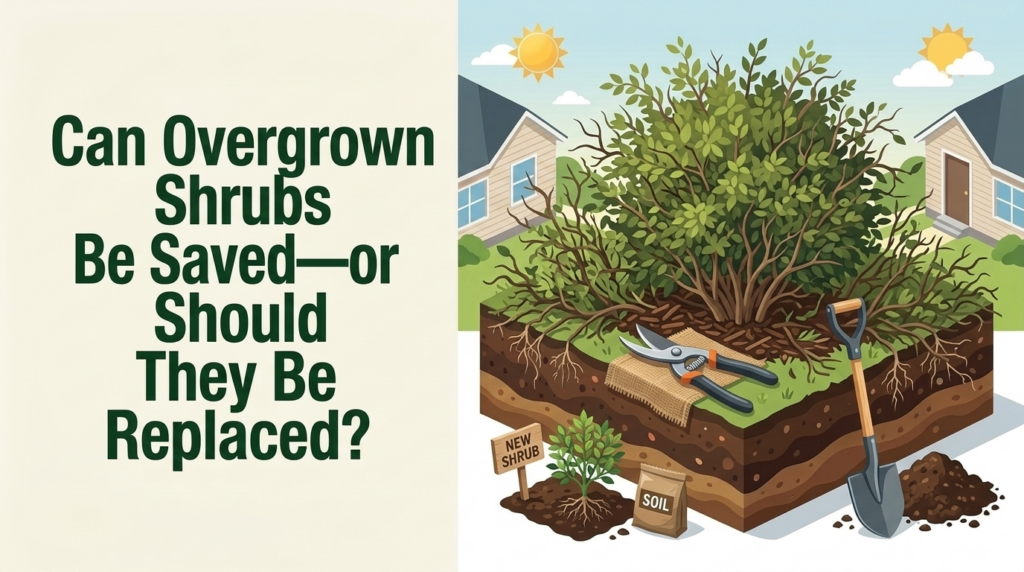
A shrub that’s outgrown its spot, gone bare at the bottom, or turned into a leggy, top-heavy mess isn’t automatically a lost cause — but it isn’t automatically savable either, and guessing wrong in either direction wastes either a perfectly good shrub or a full season waiting on one that was never coming back. Overgrown shrub pruning has a real answer for most situations, but it depends on something size alone can’t tell you: what species is actually in the ground, and whether that species is even capable of regenerating from the kind of cut it would take to fix it.
Save-or-Replace Quick Reference
| Signs the Shrub Can Likely Be Saved | Signs Replacement Makes More Sense |
|---|---|
| Species is known to tolerate hard pruning (see list below) | Species is a needled evergreen — juniper, pine, spruce |
| Some healthy green growth still present throughout, not just at the tips | Mostly dead, bare, or hollow wood with little live growth left |
| Overgrowth is from years of neglect, not disease or pests | Decline is from disease, pest damage, or root/structural problems |
| Root system and trunk/main stems are sound | Trunk or main stems are split, rotted, or structurally compromised |
| You can accept reduced bloom or a rough look for 1–3 seasons | The spot needs to look finished again quickly |
| Shrub is otherwise well-placed for its mature size | Shrub was always going to outgrow this spot again |
Start With the Species, Not the Size
The single most common mistake in deciding whether an overgrown shrub can be saved is judging by how bad it looks rather than what it actually is. A ten-foot-tall, badly leggy forsythia and a ten-foot-tall, badly leggy juniper can look almost equally rough, but one of them will respond to a hard cutback with a full flush of vigorous new growth, and the other one is biologically incapable of doing that at all. Size, density, and overall appearance describe the symptom. Species identity is what actually determines the prognosis, because it determines whether the plant can regenerate new growth from old, bare wood in the first place — and that single fact matters more to the save-or-replace decision than anything about how the shrub currently looks.
Not knowing a shrub’s exact name doesn’t rule out a reasonable guess at its category, either. A multi-stemmed shrub that drops its leaves in fall and shows visible dormant buds along bare stems through winter is very likely a deciduous species with at least some tolerance for hard pruning — that’s the group most of the tolerant shrubs below belong to. A shrub that stays green year-round with needle- or scale-like foliage rather than broad leaves is almost certainly a needled evergreen, and those are the ones where rejuvenation pruning generally isn’t an option at all. That one distinction — deciduous and bare in winter versus evergreen and needled — gets most homeowners most of the way to the right category before ever needing a positive species ID.
Signs a Shrub Can Be Rejuvenated
A shrub is generally a good candidate for rejuvenation when it’s a known hard-pruning-tolerant species (the list below covers the most common examples), when it’s still producing some healthy new growth somewhere on the plant even under all the overgrowth — evidence the plant has the vigor to regrow more of it once given room and light — and when the overgrowth itself is the result of years without pruning rather than a symptom of disease, pest damage, or a struggling root system. A structurally sound trunk and main stems matter too: rejuvenation pruning asks a plant to regrow a large portion of its top growth, and that’s a reasonable ask of a plant whose foundation is healthy, but not of one that’s already declining from something pruning can’t fix.
Signs Replacement Makes More Sense
Replacement is usually the better call when the shrub is a needled evergreen — juniper, pine, spruce, and similar species simply can’t produce new growth from bare, leafless wood, so a hard cutback on one of these doesn’t rejuvenate it, it just leaves a dead, gapped skeleton that was a shrub. It’s also the better call when what’s overgrown is mostly dead or hollow wood with little live growth actually left to work with, when the decline traces back to disease or a pest problem rather than simple neglect, or when there’s real structural damage — a split trunk, rotted main stems — that pruning alone won’t resolve. And even for a genuinely rejuvenation-tolerant species, replacement can still be the more practical choice if the spot needs to look reasonably finished again soon, since rejuvenation pruning trades a season or more of rough appearance for a full plant recovery rather than delivering an instant fix.
What Is Rejuvenation Pruning?
Rejuvenation pruning is the deliberate, severe removal of most or all of a shrub’s old top growth, done specifically to force a full flush of vigorous new growth from lower on the plant rather than to maintain its current shape. It works because of how woody plants respond to a hard cut: the buds nearest the cut — whether that’s a stub left after a severe cutback or a stem cut near ground level — respond by growing rapidly, redirecting the plant’s energy into fast new growth right at that point rather than the slower, more distributed growth an unpruned or lightly pruned plant produces. That response is exactly what turns an overgrown, hollow, or bare-bottomed shrub back into a full one — but only in species built to regenerate that way, which is why rejuvenation pruning is a call to make by species, not by how rough the plant currently looks.
It’s also worth understanding why rejuvenation pruning deliberately goes big rather than trimming lightly. Removing just the growing tips of a plant’s stems actually produces more branching overall than removing a large portion of the stem does — light tip pruning is the right call for shaping a healthy plant. But an overgrown, hollowed-out, or badly leggy shrub doesn’t need more branching at the tips; it needs an entirely new structure built from the base up, which only comes from the more dramatic response a severe cut triggers. That’s the distinction between routine shaping and true rejuvenation — they’re solving different problems, and using light tip-pruning on a shrub that actually needs rejuvenation just maintains the same overgrown shape indefinitely without ever fixing it.
One-Year vs Three-Year Rejuvenation
There are two standard approaches to rejuvenation pruning, and which one fits depends on how much the shrub’s appearance can afford to suffer in the short term. The one-year method is the more dramatic of the two: the entire shrub is cut back to roughly four to six inches above the ground in a single session, typically in late winter or early spring before new growth begins — the same general seasonal window covered in our Spring Cleanup Checklist. It’s fast, and for a tolerant species it produces a strong flush of new growth that same season, but the shrub effectively disappears from the landscape for a stretch while it regrows, which isn’t practical for a foundation planting or a prominent spot where a bare gap for a season or more isn’t acceptable.
The three-year gradual method spreads the same total renewal out to avoid that gap. In year one, roughly a third of the shrub’s largest, oldest stems are removed at ground level, leaving the rest of the plant intact and still providing some coverage. In year two, about half of the remaining old stems come out, along with some thinning of the new growth that came in from year one’s cut. By year three, the last of the original old wood is removed, and what’s left is an entirely renewed plant built from three years of new growth rather than one dramatic cut. It takes longer to reach full results, but the shrub keeps some presence in the landscape the entire time, which makes it the better choice for a hedge, a foundation planting, or anywhere a bare stretch isn’t an option.
Shrubs That Tolerate Heavy Pruning
A number of common multi-stemmed deciduous shrubs respond well to renovation pruning, including a hard cutback to four to six inches when the one-year method is the right fit: lilac, forsythia, beautybush, mockorange, viburnum, shrub dogwood, honeysuckle, spirea, barberry, flowering quince, ninebark, and smokebush all fall into this category. Privet, commonly grown as a deciduous hedge, can also recover from severe pruning provided it’s shaped regularly through the regrowth period rather than left alone to regrow however it wants.
What these species have in common is a multi-stemmed growth habit and the biological ability to push strong new growth from old wood or from the base — the same trait that makes them tolerant of the hard cuts described above, and generally the same trait that makes a species show up on this list rather than the one below.
Technique matters even on a tolerant species. Cuts should go close to ground level using clean, sharp tools, since a ragged or crushed cut heals more slowly and is a more likely entry point for disease than a clean one. On a multi-stemmed shrub, staggering the cut heights slightly across different stems, rather than cutting every single stem to the exact same height, tends to produce a fuller, more natural-looking regrowth pattern than a uniform “stump” cut does — a small detail, but one that affects how the plant actually looks for the year or more it spends regrowing.
Shrubs That Don’t
Needled and scale-leaved evergreens are the clearest exception: junipers, pines, and spruces can’t initiate new growth from bare branches at all, so an overgrown specimen from any of these genera can’t be severely pruned back into shape the way a lilac or forsythia can — cutting into the bare interior simply leaves permanent dead wood with nothing behind it to regrow. Boxwood and yew are a related but slightly different case: both resist renovation pruning as well, and cutting either one back into the already-dead or bare portions of a branch creates a large, open gap that won’t fill back in, even though both are technically broadleaf rather than needled evergreens. For all of these, hard rejuvenation pruning isn’t really an option in the way it is for the tolerant deciduous shrubs above — it’s closer to a decision about how much of the plant to remove permanently.
How Long Recovery Takes
Recovery timelines vary meaningfully by species and by how the plant blooms, and it’s worth setting expectations before committing to rejuvenation rather than after. Spring-blooming shrubs that get a hard rejuvenation cut typically skip flowering entirely the following season, since the cut removes the wood that would have carried next year’s buds along with everything else — that’s a normal, temporary trade-off, not a sign the pruning went wrong. Some species take considerably longer than a single missed season: lilac specifically can take three to five years to return to a full, reliable bloom after severe rejuvenation pruning, even though the plant itself typically regrows its foliage and structure well before that. Evergreens that do tolerate some renewal pruning can take even longer to look genuinely good again — five years or more isn’t unusual — which is part of why replacement is so often the more practical call for an evergreen specimen rather than a strict biological necessity.
What to Plant If Replacement Is Better
When replacement turns out to be the right call, it’s worth treating the decision as a chance to avoid ending up back in the same spot in another decade rather than simply swapping in the same species again. Matching a new shrub’s actual mature size — not its size at the nursery — to the space available is the single biggest factor in whether a new planting stays manageable long-term or eventually becomes another overgrown foundation shrub needing this same decision made again. Slower-growing cultivars and dwarf varieties of many popular landscape shrubs exist specifically for tight foundation spaces, and they’re often a better long-term fit than a standard-size shrub that will need constant pruning to keep in bounds. Sun exposure, soil drainage, and how close the spot is to a walkway, window, or the house foundation itself are all worth factoring in at planting time, since those conditions are usually exactly what pushed the original shrub to outgrow its space or decline in the first place.
When Professional Pruning Help Makes Sense
Telling a genuinely rejuvenation-tolerant shrub apart from one that’s better off replaced isn’t always obvious without knowing the species and assessing how much healthy wood is actually left to work with, and choosing the wrong approach either wastes a shrub that could have been saved or spends a season nursing one that was never coming back. Our Plant Pruning service handles exactly this kind of species-specific assessment, including which rejuvenation method fits a given plant and timeline. We cover the same species-specific approach for a full hedge rather than a single shrub in our guide on boxwood and hedge pruning, and our Maryland Shrub Pruning Calendar ⚠️ covers the seasonal timing question for everything else getting pruned on a property alongside a rejuvenation project.
Not sure whether a specific overgrown shrub is worth saving? Request a free estimate and we’ll assess it in person rather than guess from a description.