
Knowing when to mulch Maryland landscape beds is less about a single calendar date and more about matching the timing to what a specific bed actually needs — because “once a year, every spring” is a habit, not a strategy, and it leads to exactly the kind of over-accumulated, under-performing mulch layer that causes more problems than it solves. Some beds genuinely need fresh material every season. Others just need the existing layer raked and refreshed, and a few don’t need anything at all despite looking due for it. This guide breaks down the actual signals worth watching for — depth, function, and season — rather than defaulting to a fixed schedule regardless of what’s happening in the bed.
Best Time to Mulch: Quick Answer
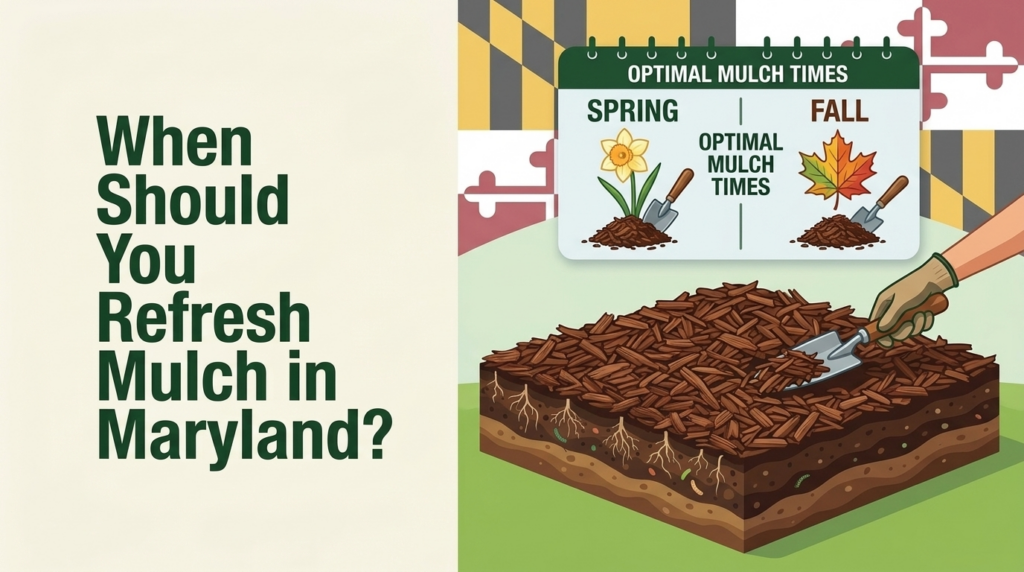
For most Cecil and Harford County landscape beds, the optimal spring mulching window is roughly the last two weeks of April through mid-May — late enough that soil has warmed for beneficial microbial activity and root growth, but early enough to get ahead of the soil-temperature signal that triggers weed seed germination. Fall mulching, typically done once temperatures cool but before the ground freezes, is a legitimate second window, particularly for moisture retention and winter root protection rather than weed prevention. Between those two windows, the honest answer to “when should I refresh” is: whenever the existing layer has actually stopped functioning, not automatically every spring regardless of condition.
Spring Mulching
Spring is the higher-value window for weed prevention specifically, and the timing within spring matters more than most homeowners realize. Weed seeds in a bed aren’t waiting for a mulching schedule — they germinate based on soil temperature and light exposure, so mulch applied before that germination begins in earnest cuts off both cues those seeds need. Mulch applied after weeds have already started coming up doesn’t prevent them; it just makes them harder to see until they’re already established. That’s why the last two weeks of April through mid-May is the target window for Cecil County: it’s positioned to catch soil after it’s warmed enough to matter for plant growth, but before it’s warmed enough to matter for weed germination.
Most homeowners mulch on a schedule driven by convenience — a free weekend, mulch on sale at a home improvement store, or beds finally looking bad enough to prompt action — rather than by what the beds and soil conditions actually call for. That’s a reasonable way to get mulch down, but it’s not the same as timing it for maximum effect. Our Spring Mulching Guide covers that full spring window in more depth, including mulch selection for different bed types.
Fall Mulching
Fall mulching serves a different purpose than spring mulching, and it’s worth understanding that distinction rather than treating fall as simply a second chance at the same spring goal. Moisture retention and soil temperature moderation matter through the growing season, but they also matter specifically for root development and insulation heading into winter — mulch acts as a buffer between plant roots and the temperature extremes and drought stress that can otherwise stress a root system heading into dormancy. Fall mulching is less about getting ahead of weed germination, since most weed pressure is a spring-and-summer problem, and more about protecting root systems through winter and giving beds a clean, finished look heading into the dormant season.
Susky’s seasonal refresh approach reflects that same distinction — spring and fall updates aren’t two identical passes at the same goal, they’re addressing different needs at different points in the year. In practice, fall mulching works best once temperatures have cooled and active summer growth has slowed, but before the ground actually freezes — early enough that the mulch has settled and is doing its insulating job before winter’s coldest stretch arrives, rather than being applied on top of already-frozen or frost-heaved soil where it does less good. Beds with plants that are marginal for the local climate, or newer plantings still establishing their root systems, tend to benefit the most from a fall pass specifically, since they have the least buffer against a hard winter.
Signs You Actually Need More Mulch
A few concrete signals are more reliable than “it’s been about a year”: bare soil visibly showing through in patches, mulch that’s thinned enough that weeds are germinating at a noticeably higher rate than in a correctly covered bed, and a measured depth that’s dropped below two inches in a trowel check. Any of those means the mulch has stopped doing its actual job — suppressing weeds and holding moisture — even if it still has some color left and looks reasonably tidy from a distance. A bed heading into a season with active plant growth or known weed pressure is also a reasonable candidate for a refresh even if the depth is borderline, simply because the cost of being caught understocked mid-season is higher than the cost of topping off a little early.
Signs You Don’t Need More
A bed that still measures a solid two to three inches when checked with a trowel, shows minimal bare soil, and isn’t showing an unusual amount of weed breakthrough is doing its job regardless of how faded or dull it looks on the surface. Adding a fresh layer on top of a bed that’s already functioning correctly is exactly how beds end up accumulating five, six, or more inches of material over a few years — the single most common and most avoidable mulching mistake. If the only complaint about a bed is that the color has faded, that’s a cosmetic issue, not a functional one, and it’s worth treating it as a separate decision rather than an automatic trigger for a full fresh layer.
Color Fade vs Functional Breakdown
This distinction is worth being direct about, because it’s genuinely counterintuitive: mulch that looks tired and gray isn’t necessarily mulch that’s stopped working. Color fade is mostly a surface phenomenon caused by UV exposure and weathering — it affects how the top layer looks, not how much moisture the full depth is retaining or how effectively it’s blocking light from weed seeds underneath. Functional breakdown is a different process entirely: it’s the gradual decomposition of the mulch itself — our Benefits of Mulching guide covers this decomposition process and its upside for soil health in more depth — typically over the 12 to 18 months hardwood mulch takes to break down, which is what actually reduces coverage depth and lets more light and moisture escape to the soil surface. A bed can look noticeably faded while still measuring a full three inches deep and suppressing weeds effectively, and a bed can still look relatively fresh in color while having thinned out below the functional threshold. Depth, checked directly, is the reliable signal — color is not.
Should Mulch Be Turned Instead of Replaced?
For a bed that’s faded in color but still at or near the correct depth, turning or raking the existing layer is usually the better move over adding a full fresh layer. Raking loosens compacted material, exposes less-weathered mulch from underneath the surface layer, and restores a reasonable amount of visual freshness without adding any material at all — which matters, since a bed already at two to three inches doesn’t have room for more without tipping into over-application territory. Turning isn’t a substitute for eventual replacement — the material underneath is still decomposing on its own timeline regardless of how often it’s raked — but it buys real time on beds that are cosmetically tired rather than functionally depleted, and it’s a far better default than reflexively adding a new layer on top of one that’s already doing its job.
The practical technique is straightforward: work a rake or cultivating tool through the top inch or two of mulch, breaking up any crusted or matted surface and turning the weathered top layer under while bringing less-faded material up. This is also a natural moment to check actual depth while you’re already in the bed, since it takes no extra time to press a trowel in at a few points and confirm the layer is still where it should be before deciding a rake-through is sufficient rather than a fuller refresh.
Weed Removal and Edging Before Mulch
Mulch timing doesn’t mean much if the bed prep underneath it is skipped. Existing weeds should be pulled before fresh mulch goes down — mulching over actively growing weeds doesn’t kill them, it just makes them harder to spot and pull later once they’re established underneath the new layer. Bed edging matters just as much: grass rhizomes creeping in from an adjacent lawn are a major, ongoing weed source that mulch timing alone never addresses, since they spread underground regardless of what’s covering the surface above them. Our guide on weed control in landscape beds covers the fuller sequence — pre-emergent timing, mulch depth, and edging together — since mulch refresh timing is really just one piece of that larger picture, not a standalone fix.
Pruning Before Mulching
Pruning overgrown shrubs and plants before fresh mulch goes down is a step that’s easy to skip but makes a real difference in the finished result. Trimming back growth that’s sprawled over bed edges gives mulch a clean line to work with rather than being spread awkwardly around and under overgrown branches, and it makes the bed genuinely easier to mulch correctly — reaching the soil surface evenly, maintaining consistent depth, and keeping material off stems and trunks the way it should be. Doing pruning first also means the plant debris and clippings are cleared out before mulch goes down, rather than getting buried under it. Our Plant Pruning service is timed to work ahead of seasonal mulching for exactly this reason, rather than as a separate, disconnected visit.
Seasonal Mulch FAQs
Is spring or fall better for mulching in Maryland? Spring is generally better for weed prevention, since correctly timed spring mulch gets ahead of weed seed germination. Fall is better for moisture retention and root protection heading into winter. Many beds genuinely benefit from both, but if only one refresh happens per year, the goal for that bed should drive which season makes more sense.
How often should mulch actually be replaced? There’s no fixed annual rule — it depends on depth and condition, not the calendar. A bed still at two to three inches and functioning correctly doesn’t need replacement just because a year has passed; a bed that’s thinned below two inches or accumulated past three needs attention regardless of how recently it was last touched.
Can I just add mulch on top of what’s already there? Only if the existing layer, plus what’s being added, stays within the two-to-three-inch range. Topping off a thin layer to bring it back to depth is fine. Adding a full new layer on top of an already-adequate one is how beds end up over-mulched.
Does faded mulch need to be replaced? Not necessarily. Faded color is usually a surface effect from UV exposure, not a sign that the mulch has stopped suppressing weeds or retaining moisture. Checking actual depth with a trowel is a more reliable signal than color alone.
Should I mulch before or after planting new annuals or perennials? Mulch generally goes down after new plants are in the ground, worked carefully around the base of each one rather than covering the planting hole itself. Mulching first and then trying to plant through it usually means disturbing the mulch layer anyway, so there’s little advantage to doing it in that order.
Not sure whether a specific bed on your property needs a full refresh, a top-off, or just a rake-through? Our Mulch service starts with an assessment of what’s actually there, not an automatic fresh layer regardless of what the bed needs.