
There’s no single answer to when you should prune hydrangeas in Maryland, and that’s exactly why so many otherwise healthy hydrangeas stop blooming after a well-intentioned pruning session. Unlike most shrubs, where bloom time alone tells you whether a plant flowers on old wood or new wood, hydrangeas split that rule across four commonly planted types — bigleaf, panicle, smooth, and oakleaf — and each one follows its own timing. Prune a bigleaf hydrangea the way you’d correctly prune a panicle hydrangea and you can lose an entire season of flowers on a plant that otherwise looks completely healthy. This guide breaks hydrangea pruning down by type, so the timing question has a real answer instead of a guess.
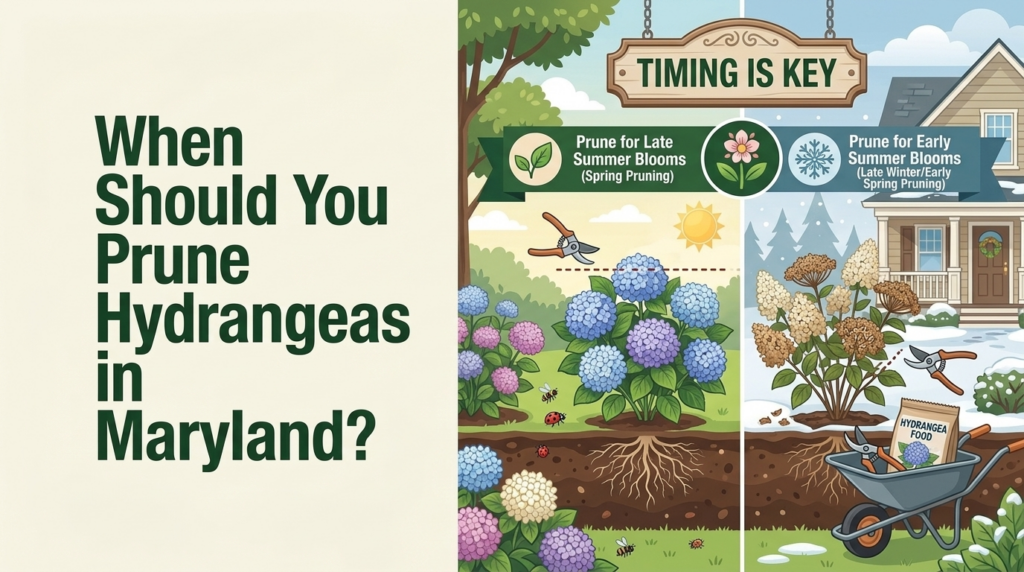
The Answer Depends on the Type of Hydrangea
Four hydrangea types are common across Maryland landscapes, and they don’t share one pruning calendar: bigleaf hydrangea (Hydrangea macrophylla), panicle hydrangea (Hydrangea paniculata), smooth hydrangea (Hydrangea arborescens), and oakleaf hydrangea (Hydrangea quercifolia). Two of these bloom on old wood, meaning the flower buds for this year’s blooms were already set on the plant last season. Two bloom on new wood, meaning this year’s blooms come from growth the plant produces this same season. Get that split right for the specific hydrangea in the ground and the timing question mostly answers itself — get it backwards, and the consequences range from a missed bloom season to a plant that doesn’t flower at all for a year or more.
If there’s any uncertainty about which type is actually planted, University of Maryland Extension’s guidance is worth taking seriously: no pruning at all is a safer choice than pruning at the wrong time. A hydrangea that goes unpruned for a season loses nothing it can’t make up later. One pruned incorrectly on old wood can lose flower buds it won’t replace until the following year.
Old Wood vs New Wood
The dividing line among hydrangea types comes down to when each one actually forms its flower buds. Old-wood bloomers set next year’s flower buds within weeks of this year’s blooms fading, so those buds sit on the plant, dormant, through the entire fall and winter — prune during that window and you’re cutting off flowers that haven’t opened yet. New-wood bloomers form their flower buds on the current season’s growth, so they can be cut back hard in late winter without losing a single bloom; if anything, the resulting flush of new growth tends to produce a heavier bloom than an unpruned plant would.
Bigleaf and oakleaf hydrangeas bloom on old wood. Panicle and smooth hydrangeas bloom on new wood. That’s the entire rule this guide builds from — everything below is really just that same distinction applied to four specific plants, each with its own quirks worth knowing before the pruners come out. Our Maryland Shrub Pruning Calendar ⚠️ covers this same old-wood/new-wood mechanic across shrubs generally, if it helps to see how hydrangeas fit into the broader picture of what’s getting pruned on a property and when.
Bigleaf Hydrangeas
Bigleaf hydrangea — the classic mophead and lacecap types most people picture when they hear “hydrangea” — is where old-wood pruning mistakes happen most often, largely because most bigleaf varieties bloom exclusively on old wood. The correct window is immediately after the flowers fade, not before, and not too long after: prune too early and you’re cutting current-season stems the plant hasn’t finished using; wait too long into fall and winter and you risk cutting into the buds already set for next year. Old-wood bigleaf hydrangeas can be trimmed to about 12 inches off the ground if a harder cutback is needed, but that height reduction comes at the cost of that year’s blooms, since the flower buds were already sitting on the wood being removed.
A growing number of newer bigleaf cultivars are remontant — meaning they bloom on both old and new wood, which gives them more forgiving timing than traditional varieties. A remontant bigleaf hydrangea can be pruned either in early spring or right after its first flush of flowers fades, since a second round of buds will still form on new growth later in the season. If it isn’t clear which category a specific plant falls into, treating it as an old-wood bloomer and pruning immediately after bloom is the safer default. For a plant that’s grown dense over several seasons, thinning out some interior stems — rather than shearing the whole plant back uniformly — improves air circulation through the canopy and measurably reduces disease pressure, which matters more for bigleaf hydrangea than for any of the other three types covered here.
Panicle Hydrangeas
Panicle hydrangea blooms on new wood, which makes it one of the more forgiving hydrangeas to prune correctly: cut it back in late winter or early spring, before new growth initiates, and nothing about that timing removes any flowers, since the buds haven’t formed yet. Plants can be pruned to about 12 inches off the ground for a hard reset, or left taller for large-maturing varieties that naturally want more height — either approach is fine as long as the cut happens before spring growth starts.
Panicle hydrangea is also sometimes trained and maintained as a “standard” — pruned over several years into the form of a small ornamental tree with a single trunk and a rounded crown, rather than left as a multi-stemmed shrub. A tree-form panicle hydrangea needs a different approach than a standard shrub-form plant: the same late-winter timing still applies for shaping the crown, but the trunk itself shouldn’t be cut back hard the way a shrub-form plant’s stems can be, since a renewal cut at the base would undo years of training and destroy the tree shape entirely.
Smooth Hydrangeas
Smooth hydrangea — the type behind the popular “Annabelle” variety, among others — also blooms on new wood, and follows the same late-winter-to-early-spring pruning window as panicle hydrangea. It’s arguably the most tolerant of hard pruning of any type covered here: cutting the entire plant back to about 12 inches off the ground is a legitimate, commonly recommended approach, not a last resort, since the plant will still produce a full flush of new growth and flowers that same season.
That tolerance for a hard annual cutback is actually part of why smooth hydrangea has a reputation among some gardeners for flopping — a severe cutback each year produces vigorous new growth that’s often taller than the stem diameter can fully support once the season’s large flower heads add weight. Leaving a slightly taller framework of older stems in place, rather than cutting every stem back to the same low height every year, can reduce flopping without meaningfully changing the plant’s bloom timing.
Oakleaf Hydrangeas
Oakleaf hydrangea blooms on old wood, following the same immediately-after-bloom pruning rule as traditional bigleaf hydrangea. It can be pruned to the same height range as the other types — down to roughly 12 inches for a hard cutback — or left taller, which is often the better choice for large-maturing oakleaf varieties that are typically grown more for their size, fall foliage color, and exfoliating winter bark than for tight, compact form.
Oakleaf hydrangea tends to need far less routine pruning than bigleaf hydrangea in practice, since its natural growth habit is already fairly open and its form generally holds up well without regular shaping. Most of the pruning oakleaf hydrangea actually needs is corrective — removing dead, damaged, or awkwardly crossing stems — rather than the size-management pruning bigleaf hydrangea often requires in a smaller garden bed.
Why Hydrangeas Sometimes Stop Blooming After Pruning
Incorrect pruning timing on an old-wood bloomer is the single most common reason a hydrangea skips a season, and it comes down to a plant that simply can’t replace flower buds once they’re cut off — the buds for this year’s blooms were already formed and sitting on last year’s wood, and removing that wood removes the flowers along with it. But pruning timing isn’t the only cause, and it’s worth ruling out the others before assuming a mistimed cut is to blame.
Bigleaf hydrangea in particular is vulnerable to winter and spring weather extremes that can kill overwintering flower buds without any pruning involved at all — extended periods of severe cold, drought stress heading into winter, or a late spring frost after buds have already started to swell can all wipe out a season’s blooms on a plant nobody touched with pruners. Deer browsing is another common culprit, since deer will eat tender emerging flower buds along with new foliage, and they’ll do it repeatedly through the season if a property isn’t protected. Overfertilizing with a high-nitrogen product is a less obvious cause: it pushes the plant toward leafy growth at the direct expense of flower production, which is why a balanced or phosphorus-leaning fertilizer is generally the better choice for a hydrangea grown for blooms rather than foliage. And severe renewal pruning — even done at the technically correct time of year — can still leave a plant skipping blooms for a full year or longer simply because it’s redirecting its energy into rebuilding structure rather than flowering.
Deadheading vs Pruning
Deadheading and pruning aren’t the same task, and conflating them is part of why some homeowners end up doing more cutting than a hydrangea actually needs. Deadheading removes only the spent flower head itself, cut back to the first set of healthy leaves at the branch tip — it doesn’t go any further down the stem, and it isn’t necessary for the plant’s health at all; it’s purely a matter of appearance, tidying up faded blooms before they turn brown and papery. Because it only affects the very tip of the branch, deadheading can be done at essentially any time after a bloom fades without the timing risk that comes with structural pruning.
Pruning is a different category of cut entirely: removing whole stems down near the base, or shortening tall stems significantly to control size and shape. That’s the type of cut where old-wood-versus-new-wood timing actually matters, since it’s capable of removing the wood carrying next year’s flower buds. A homeowner who wants to keep a hydrangea tidy through the season can deadhead freely; a homeowner looking to control a plant’s overall size needs to work within that type’s correct pruning window instead.
How Hard Can You Cut Hydrangeas Back?
How hard a hydrangea can be cut back safely depends entirely on which wood type it blooms on, not on how vigorous or overgrown the plant looks. New-wood bloomers — panicle and smooth hydrangea — tolerate a genuinely hard annual cutback to around 12 inches off the ground without sacrificing that season’s flowers, since the wood carrying this year’s buds hasn’t grown yet at the time of pruning. Old-wood bloomers — bigleaf and oakleaf hydrangea — can technically be cut to the same height, but doing so removes the buds for that year’s blooms along with the old wood, so a hard cutback on these types is a trade-off between size control and a missed bloom season, not a cost-free option the way it is on the new-wood types.
Any hydrangea, regardless of type, that undergoes true renewal pruning — cutting most or all of the plant back hard, usually to rescue an overgrown or storm-damaged specimen — should be expected to bloom poorly or not at all for a year or more while it rebuilds its branch structure. That’s a normal, temporary response rather than a sign the plant was damaged permanently, but it’s worth knowing in advance so a quiet season after a hard cutback doesn’t read as something having gone wrong.
When Professional Help Makes Sense
Identifying which hydrangea type is actually in the ground is often the hardest part of getting this right, especially on a property with several hydrangeas planted at different times or a plant that’s been there long enough that nobody remembers what was originally purchased. Our Plant Pruning service is built around exactly that kind of species-specific timing and technique — matching the right cut to the right plant rather than treating every shrub on a property the same way. Our Tree & Shrub Pruning guide covers the broader philosophy behind that approach, and our Maryland Shrub Pruning Calendar ⚠️ lays out timing for the rest of a typical Maryland landscape beyond hydrangeas specifically. Our Spring Cleanup Checklist is also worth checking as part of a broader spring task list, since hydrangea pruning is usually just one piece of a larger seasonal cleanup.
Not sure which hydrangea type is actually growing on your property? Request a free estimate and we’ll identify it and prune it on the correct schedule rather than guess from a description.